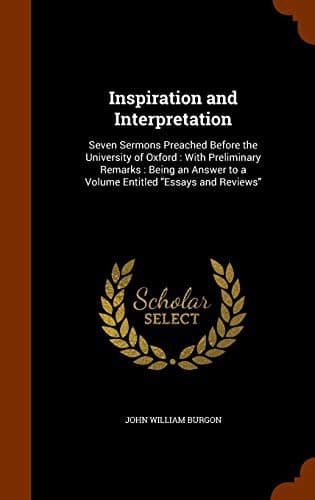
Inspiration and Interpretation: Seven Sermons Preached Before the University of OxfordBurgon, John William
Religion
Inspiration and Interpretation: Seven Sermons Preached Before the University of Oxford
Burgon, John William
Bible -- Criticism, interpretation, etc.; Bible -- Inspiration; Sermons, English
(iv) "Each writer, each successive age, has characteristics of its own,
as strongly marked, or more strongly, than those which are found in the
authors or periods of classical Literature. These differences are not to
be lost in _the idea of a Spirit from whom they proceed, or by which
they were overruled_. And therefore, illustration of one part of
Scripture by another should be confined to writings of the same age and
the same authors, except where the writings of different ages or persons
offer obvious similarities. It may be said, further, that illustration
should be chiefly derived, not only from the same author, _but from the
same writing, or from one of the same period of his life_. For example,
the comparison of St. John and the 'synoptic' Gospels, or of the Gospel
of St. John with the Revelation of St. John, will tend _rather to
confuse than to elucidate the meaning of either_." (pp. 382-3.)--But
really, in reply, it ought to suffice to point out that the result of
the Church's experience for 1800 years has been the very opposite of
the Professor's. "_The idea of a SPIRIT from whom they proceeded_," is,
to the thoughtful part of mankind, _the only intelligible clue_ to the
several books of Holy Scripture, from Genesis to Revelation! Hence "the
marginal references to the English Bible," (to which Mr. Jowett devotes
a depreciatory half page,) so far from being the dangerous or useless
apparatus which he represents, we hold to be an instrument of paramount
importance for eliciting the true meaning of Holy Writ.--In a word, he
is reasoning about the Bible on _the assumption_ that the Bible is _like
any other book_.
(v) "To attribute to St. Paul or the Twelve the abstract notion of
Christian Truth which afterwards sprang up in the Catholic Church ... is
the same error as to attribute to Homer the ideas of Thales or
Heraclitus, or to Thales the more developed principles of Aristotle and
Plato." (p. 354.)--_Not if St. Paul and the Twelve were inspired._
(vi) He bids us remark, with tedious emphasis, that although the same
philological and historical difficulties which occur in Holy Scripture
are found in profane writings, yet "the meaning of classical authors is
known with comparative certainty; and the interpretation of them seems
to rest on a scientific basis.... _Even the Vedas and the Zendavesta_,
though beset by obscurities of language probably greater than are found
in any portion of the Bible, are interpreted, at least by European
scholars, according to fixed rules, and beginning to be clearly
understood." (p. 335.)
But at the end of several weak sentences, through which the preceding
fallacy is elongated into distressing tenuity, _who_ does not
exclaim,--The supposed "scientific" basis on which the interpretation of
books in general rests, is simply this; (=1=) that being _merely
human_, and (=2=) _not professing_ to have any other than their obvious
literal meaning,--they are all interpreted in the obvious ordinary way!
Public-domain text, read in full here on John Shaqi.
Reviews
Reviews
No reviews yet
Be the first to share your thoughts on this work.
Elsewhere in the archive
Join the Discussion
Join the discussion
Sign in to leave a comment or review.
Sign InorCreate an account