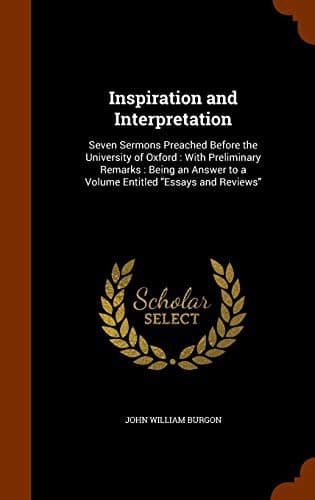
Inspiration and Interpretation: Seven Sermons Preached Before the University of OxfordBurgon, John William
Religion
Inspiration and Interpretation: Seven Sermons Preached Before the University of Oxford
Burgon, John William
Bible -- Criticism, interpretation, etc.; Bible -- Inspiration; Sermons, English
(viii) Again,--"If it is not held to be a thing impossible that there
should be agreement in the meaning of _Plato and Sophocles_, neither is
it to be regarded as absurd, that there should be a like agreement in
the interpretation of _Scripture_?" (p. 426.)--The whole force of this
argument clearly consisting in the strictly equal claims of these books
to Inspiration.--Elsewhere, Mr. Jowett expresses the same thing more
unequivocally:--The old "explanations of Scripture," (he says,) "are no
longer tenable. They belong to a way of thinking and speaking which was
once diffused over the world, but has now passed away." Having quietly
_assumed_ all this, the Reverend writer proceeds:--"And what we give up
as a general principle, we shall find it impossible to maintain
partially; _e.g._ in the types of the Mosaic Law, and the double
meanings of Prophecy, at least _in any sense in which it is not equally
applicable to all deep and suggestive writings_." (p. 419.)
(ix) "Still one other supposition has to be introduced, which will
appear, perhaps, _more extravagant than any which have preceded_.
Conceive then that these modes of interpreting Sophocles (!) had existed
for ages; that great institutions and interests had become interwoven
with them; and in some degree even the honour of Nations and
Churches;--is it too much to say that, in such a case, they would be
changed with difficulty, and that they would continue to be maintained
long after critics and philosophers had seen that they were
indefensible?" (pp. 336-7.)
I suppose we may at once allow Mr. Jowett most of what he asks. We may
freely grant that if the Tragedies of Sophocles _had_ exercised the same
wondrous dominion over the world which the Books of the Bible have
exercised:--if Oedipus and Jocasta and Creon; if Theseus and Dejanira
and Hercules; if Ajax, Ulysses and Minerva;--_had_ done for the world
what Enoch and Noah;--what Abraham, Isaac, and Jacob;--what Joseph, and
Joshua, and Hannah, and Samuel, and David;--what Elijah and Elisha;
what Isaiah and Jeremiah, Ezekiel and Daniel, and the rest;--what St.
Peter, and St. John, and St. Paul;--what the Blessed Virgin and her
name-sakes, have done:--In a word: had Homer's gods and heroes
altogether changed the face of society, and revolutionized the world;
_so that "great institutions and interests had become interwoven with
them, and in some degree even the honour of Nations and Churches_;"
(p. 336;)--if, I repeat, all this _had_ really and actually taken
place;--_great_ "difficulty" would, no doubt, (as Mr. Jowett profoundly
suggests,) be experienced, at the end of 2000 years, in getting rid of
them.
But since it unfortunately happens that _they have done nothing of the
kind_, we do not seem to be called upon to follow the Regius Professor
of Greek into the supposed consequences of what he admits to be an
"extravagant supposition;" and which we humbly think is an excessively
foolish one also.
Public-domain text, read in full here on John Shaqi.
Reviews
Reviews
No reviews yet
Be the first to share your thoughts on this work.
Elsewhere in the archive
Join the Discussion
Join the discussion
Sign in to leave a comment or review.
Sign InorCreate an account