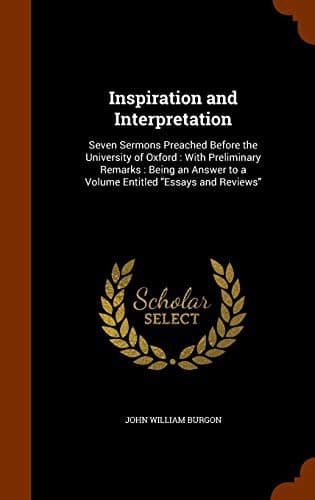
Inspiration and Interpretation: Seven Sermons Preached Before the University of OxfordBurgon, John William
Religion
Inspiration and Interpretation: Seven Sermons Preached Before the University of Oxford
Burgon, John William
Bible -- Criticism, interpretation, etc.; Bible -- Inspiration; Sermons, English
4. When the nature of these quotations, references, and allusions is
examined with care, several extraordinary phenomena present themselves,
which it seems impossible to consider without the deepest interest,
surprise, and admiration. Thus,--(i.) The New Testament writers, on
repeated occasions, display _independent knowledge_ of the Old Testament
History to which they make reference[162]. The following instances occur
to my memory:--All the later links in our LORD'S Genealogy[163]; the
second Cainan[164]: Salmon's marriage with Rahab[165]: the burial-place
of the twelve Patriarchs[166]: the age of Moses in Exod. ii. 11[167]:
that in the days of Elijah the heaven was shut up for three years _and
six months_[68]: that it was _the Devil_ who tempted Eve[169]: the
contest for the dead body of Moses[170]: the names of Pharaoh's
magicians[171]: how Abraham reasoned with himself when he prepared to
offer up his son Isaac[172]: the golden censer, mentioned in Heb. ix. 4:
Abraham's purchase of Sychem[173]; and a few other things[174].
(ii.) The same New Testament writers are observed to handle the Old
Testament Scriptures with an air of singular authority, and to exercise
an extraordinary license of quotation; inverting clauses,--paraphrasing
statements,--abridging or expanding;--and always without apology or
explanation;--as if they were conscious that they were dealing with
_their own_.
(iii.) Most astonishing of all, obviously, as well as most important, is
_the purpose_ for which the Evangelists and Apostles of our LORD make
their appeal to the Old Testament Scriptures; invariably in order _to
establish some part of the Christian Revelation_. "Every thoughtful
student of the Holy Scriptures has been struck with the circumstance
which I now allude to: the freedom, namely, with which the inspired
Writers of the New Testament appeal back to the Old; and see in it, as
its one proper theme, the Christian subject. They find themselves in
that place, at length, to which former intimations had pointed, and
recognize the connexion which they themselves have with their ancient
forerunners[175]." ... It is as if for four hundred years and upwards, a
mighty mystery,--described in many a dark place of Prophecy, exhibited
by many a perplexing type, foreshadowed by many a Divine narrative,--had
waited for solution. The world is big with expectation. The
long-expected time at last arrives. Up springs the Sun of Righteousness
in the Heavens; and lo, the cryptic characters of the Law flash at once
into glory, and the dark Oracles of ancient days yield up their wondrous
meanings! "GOD, who at sundry times and in divers manners spake in time
past unto the Fathers by the Prophets,"--in these last days speaks "unto
us by His SON:" and lo, a chorus of Apostolic voices is heard bearing
witness to the Advent of "the Desire of all nations!" ... Such is the
relation which the New Testament bears to the Old: such the true nature
Public-domain text, read in full here on John Shaqi.
Reviews
Reviews
No reviews yet
Be the first to share your thoughts on this work.
Elsewhere in the archive
Join the Discussion
Join the discussion
Sign in to leave a comment or review.
Sign InorCreate an account