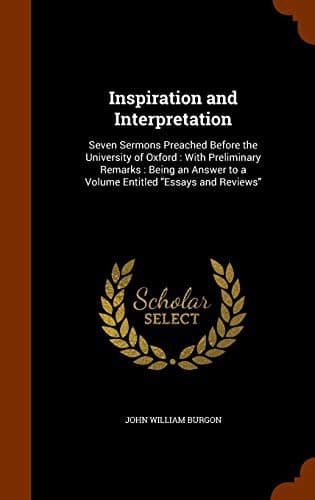
Inspiration and Interpretation: Seven Sermons Preached Before the University of OxfordBurgon, John William
Religion
Inspiration and Interpretation: Seven Sermons Preached Before the University of Oxford
Burgon, John William
Bible -- Criticism, interpretation, etc.; Bible -- Inspiration; Sermons, English
of the many quotations from the earlier Scriptures, which are found in
the later half of the One inspired Volume.
5. And thus we are led naturally to notice the extraordinary connexion
which subsists between the two Testaments. "For what is the Law," (asks
Justin, A.D. 140,) "but the Gospel foretold? or what is the Gospel, but
the Law fulfilled[176]?" "The contents of the Old and New Testament are
the same," remarks Augustine: "_there_ foreshadowed, _here_ revealed:
_there_ prefigured, _here_ made plain." "In the Old Testament there is a
concealing of the New: in the New Testament there is a revealing of the
Old[177]."--Mr. Jowett's inquiry,--"If we assume the New Testament as _a
tradition running parallel with the Old_, may not the Roman Catholic
assume with equal reason a tradition parallel with the New?"
(p. 81.)--shews a truly childish misapprehension of the entire
question. The New Testament is not a "parallel tradition" at all; but a
_subsequent Revelation from Heaven_.
6. Now I might pursue these remarks much further: for it would be well
worth while to exhibit what an extraordinary sameness of imagery,
similarity of allusion, and unity of purpose, runs through the writings
of either Covenant;--phenomena which can only be accounted for in one
way. This subject will be found dwelt upon elsewhere; and to what has
been already delivered, I must be content here to refer the reader[178].
(Mr. Jowett himself has been struck by the phenomenon thus alluded to:
but after hinting at "some natural association" as having suggested the
language of the Prophets, he proceeds: "We are not therefore justified
in supposing any hidden connexion in the prophecies where [the prophetic
symbols] occur. _Neither is there any other ground for assuming design
of any other kind in Scripture; any more than in Plato or Homer._"
(p. 381.) ... And thus our philosopher, assuming at the outset that the
Bible is an uninspired book, is for ever coming back to the lie with
which he set out. But to proceed.)
Public-domain text, read in full here on John Shaqi.
Reviews
Reviews
No reviews yet
Be the first to share your thoughts on this work.
Elsewhere in the archive
Join the Discussion
Join the discussion
Sign in to leave a comment or review.
Sign InorCreate an account