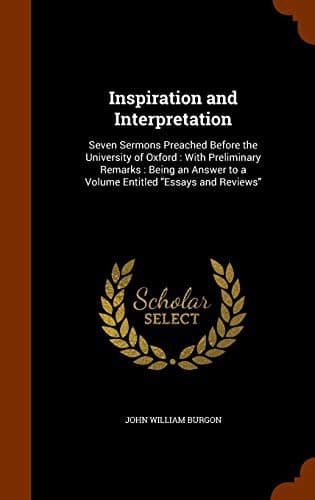
Inspiration and Interpretation: Seven Sermons Preached Before the University of OxfordBurgon, John William
Religion
Inspiration and Interpretation: Seven Sermons Preached Before the University of Oxford
Burgon, John William
Bible -- Criticism, interpretation, etc.; Bible -- Inspiration; Sermons, English
(iii) "The uncertainty which prevails in the Interpretation of
Scripture," Mr. Jowett proposes to get rid of,--(this is in fact the aim
of his entire Essay,) by denying that there are in Scripture any deeper
meanings to interpret. In the meantime, by every device in his power, he
seeks from _à priori_ considerations, (as we have seen,) to shew that no
such meanings can exist. We allow ourselves to be biassed, to a singular
extent, he says, "by certain previous suppositions with which we come to
the perusal of Scripture." (p. 342.) _But_ for this, "no one would
interpret Scripture as many do." (_Ibid._) Let us ascertain then what
these erroneous "suppositions" are.
(=1=) "The failure of a prophecy is never admitted, in spite of
Scripture and of history, (Jer. xxxvi. 30. Isaiah xxiii. Amos vii.
10-17.)" (p. 343.)
Now this can only mean two things: viz. first, that a Divine Prophecy is
_not_ an infallible utterance: and secondly, that the three places
quoted from the Old Testament are _proofs_ of the fallibility of
Prophecy; proofs which ought to overcome prejudice, and persuade men to
renounce their "previous supposition" that Prophecy is _in_fallible.
Certainly the charge is a grave one. For if _Prophecy_ is untrue, then
what becomes of Inspiration?
And yet, how stands the case? The writer seems to have expected "that no
one would refer to the passages that he has bracketed, or that all would
be too ignorant to know the utter groundlessness of his assumption. If
there are, in the whole Scripture, two past prophecies which were
signally and remarkably fulfilled, they are the first two which he has
selected as instances to be dropped down, without a remark, of the
failure of Scripture prophecies! And as to the third passage, surely it
implies an 'incuria' which might be deemed 'crassa' to have asserted
that it contained an instance of the non-fulfilment of Prophecy: for it
implies that Mr. Jowett has read the verses to which he refers with so
little attention as not to have discovered that the prediction which
failed of its fulfilment was _no utterance of Amos_, but was _the
message of Amaziah, the priest of Bethel_, in which he falsely
attributes to Amos _words he had not spoken_!... Surely such slips as
these are as discreditable to a scholar as a Divine[225]!"
And this, from a gentleman who has the impertinence to remind us
oracularly, that "he who would understand the nature of Prophecy in the
Old Testament, should have _the courage to examine how far its details
were minutely fulfilled_!" (p. 347.) Are we then to infer that Mr.
Jowett's courage failed him when he came to Amos vii. 10-17?
(=2=) "The mention of a name later than the supposed age of the
prophet is not allowed, as in other writings, to be taken in evidence of
the date. (Isaiah xlv. 1.)" (p. 343.)
Public-domain text, read in full here on John Shaqi.
Reviews
Reviews
No reviews yet
Be the first to share your thoughts on this work.
Elsewhere in the archive
Join the Discussion
Join the discussion
Sign in to leave a comment or review.
Sign InorCreate an account