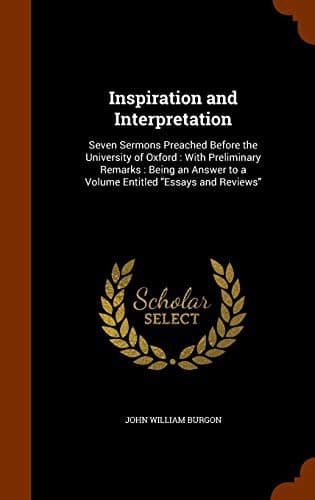
Inspiration and Interpretation: Seven Sermons Preached Before the University of OxfordBurgon, John William
Religion
Inspiration and Interpretation: Seven Sermons Preached Before the University of Oxford
Burgon, John William
Bible -- Criticism, interpretation, etc.; Bible -- Inspiration; Sermons, English
But what is the meaning of this complaint when applied to Isaiah's well
known prophecy concerning Cyrus? In the words of the excellent critic
last quoted,--"We know not that we could point to such an instance as
this in the writings of any other author of credit. Of course, Mr.
Jowett knows as well as we do the distinction between History and
Prophecy; and that the mention in any document of the name of one who
was unborn at the time fixed as the date of the writing, would be at
once a complete _disproof_ of its accuracy as a history of the past, and
a _proof_ of its accuracy as a prediction of the future. Of course he
also remembers that the point he has _to prove_ is that this passage is
History and not Prediction; and his mode of proving is this; _he
assumes that it is a history of the past_,--advancing as a charge
against the believers of Revelation, that they do not, (as they would in
any other History,) reject the genuineness of the passage because it
embalms a future name in a past history!... This audacious, (for we
cannot use a weaker word,) _assumption_ of what he has _to prove_,
pervades his Essay[226]."
And thus, into whatever department of speculation we follow this writer,
the tortuous path is still found to conduct us back to the same
underlying fallacious _assumption_,--viz. that _the Bible is like any
other Book_; in other words, is _not inspired_.
(=3=) Persons in Mr. Jowett's position, "find themselves met by a _sort
of presupposition that 'GOD speaks not as Man speaks_.'"--(p. 343.)
"A sort of presupposition," indeed!... Does the Reverend gentleman
really expect that we will stoop so low as argue _this_ point also with
him? It shall suffice to have branded him with his own words.
"The suspicion of Deism, or perhaps of Atheism, awaits inquiry. By such
fears, a good man (!) refuses to be influenced: a philosophical mind (!)
is apt to cast them aside with too much bitterness. It is better to
close the book, than to read it under conditions of thought which are
imposed from without." (p. 343.)
Well surely, the proximity to Balliol College of the scene of Cranmer
and Ridley's martyrdom, must have turned the brain of the Regius
Professor of Greek!--Let him be well assured however that not rational
"Inquiry," but irrational _assumption_; not the modest cogitations of "a
philosophical mind," but the _arrogant dreams of a weak and confused
intellect_, are what have excited such general indignation of late,
among "good men," from one end of the Kingdom to the other. Nor could
anything probably of equal pretensions be readily appealed to, which is
nevertheless more truly unphilosophical, fallacious, and foolish, than
the Essay now under consideration.
Public-domain text, read in full here on John Shaqi.
Reviews
Reviews
No reviews yet
Be the first to share your thoughts on this work.
Elsewhere in the archive
Join the Discussion
Join the discussion
Sign in to leave a comment or review.
Sign InorCreate an account