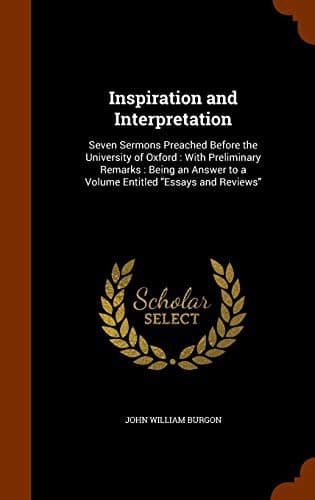
Inspiration and Interpretation: Seven Sermons Preached Before the University of OxfordBurgon, John William
Religion
Inspiration and Interpretation: Seven Sermons Preached Before the University of Oxford
Burgon, John William
Bible -- Criticism, interpretation, etc.; Bible -- Inspiration; Sermons, English
that Inspiration is consistent with "variations of _fact;_" but with
_different versions_ of the same incident, it is confessedly
compatible.)--"With inaccuracies of language in the Epistles of St.
Paul." (With _grammatical inelegancies_, no doubt; but not with _logical
inaccuracies_.)--"For these are all found in Scripture:" (This
statement, by the way, should have been substantiated by at least as
many references as there are heads in the indictment,)--"neither is
there any reason why they should not be; except a general impression
that Scripture ought to have been written in a way different from what
it has." (Just as if Mankind for 1800 years had been the victims of an
_à priori_ conception as to _how_ Holy Scripture _ought to have been_
written!)--"A principle of progressive revelation admits them all; and
this is already contained in the words of our SAVIOUR, 'Moses because of
the hardness of your hearts;' or even in the Old Testament, 'Henceforth
there shall be no more this proverb in the house of Israel?'" (O if
Catholic writers were to expound Holy Scripture with the license of
_these_ gentlemen!... That the scheme of Revelation has been
progressive, is a Theological truism. What that has to do with the
question in hand, I see not.)--"For what is progressive is necessarily
imperfect in its earlier stages:" ("Imperfect" in what sense?)--"and
_even erring_ to those who come after." (No, not in _that_ sense
imperfect, certainly!) ... "There is no more reason why _imperfect
narratives_ should be excluded from Scripture than imperfect grammar; no
more ground for expecting that the New Testament would be logical or
Aristotelian in form, than that it would be written in Attic Greek."
(Now _why_ this cloudy shuffling about "imperfect narratives,"--instead
of saying _what you mean_, like a man! Further,--Is Mr. Jowett so weak
as not to perceive that there is _no force whatever_ in his supposed
parallel? The Discourses of the Incarnate SON, for instance, are
certainly anything but "Aristotelian in form." His dialect,--(Angels
bowed to catch it, I nothing doubt!)--was that of the despised Galilee.
But need _the teaching it conveyed_ have _therefore_ been "imperfect?"
Why may not the least perfect _Greek_ be the vehicle for the more
perfect _Doctrine_? What connexion is there between the casket and the
jewel which it encloses?)
Public-domain text, read in full here on John Shaqi.
Reviews
Reviews
No reviews yet
Be the first to share your thoughts on this work.
Elsewhere in the archive
Join the Discussion
Join the discussion
Sign in to leave a comment or review.
Sign InorCreate an account