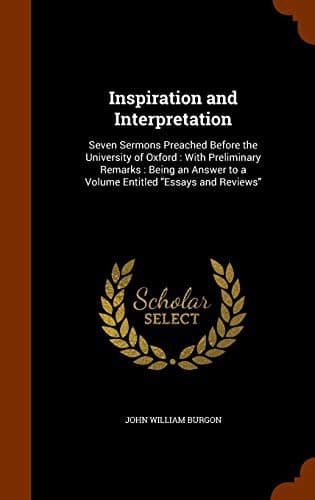
Inspiration and Interpretation: Seven Sermons Preached Before the University of OxfordBurgon, John William
Religion
Inspiration and Interpretation: Seven Sermons Preached Before the University of Oxford
Burgon, John William
Bible -- Criticism, interpretation, etc.; Bible -- Inspiration; Sermons, English
(=3=) The Reverend writer promises us help, from "another consideration
which has been neglected by writers on this subject." (The announcement
makes us attentive.)--"It is this,--that any true Doctrine of
Inspiration must conform to all well-ascertained facts of History or of
Science." (We scarcely see the drift of this ill-worded proposition; but
are disposed to assent.)--"The same fact cannot be true and untrue,"
(Who ever supposed that it could?)--"any more than the same words can
have two opposite meanings." (But why glide at once into a gross
falsity? Are there not plenty of words and speeches, of the kind called
'equivocal' or 'ambiguous,' which are of this nature? I am content to
refer this writer to _his own pages_, for the abundant refutation of his
own assertion. No man in the world knows better than Mr. Jowett that
"_the same words can have two opposite meanings_.") "The same fact
cannot be true in Religion, when seen by the light of Faith; and untrue
in Science, when looked at through the medium of evidence or
experiment." (Why not? For example,--'He maketh His Sun to rise.' 'If
GOD so clothe the grass of the field.' 'GOD said, Let there be light.'
Who sees not that the view which Faith and which Physical Science
respectively take of the same phenomenon, may essentially differ?)--"It
is ridiculous to suppose that the Sun goes round the Earth in the same
sense in which the Earth goes round the Sun;" (Very ridiculous.)--"or
that the world appears to have existed, but has not existed, during the
vast epochs of which Geology speaks to us." (Leave out the words,
"appears to have," and this also is undeniable.)--"But if so, there is
no need of elaborate reconcilements of Revelation and Science." (How
does that follow? If what is thought to be Divinely revealed, and what
is thought to be scientifically ascertained, seem to be conflicting
truths,--why should not an effort be made to reconcile them?) "They
reconcile themselves the moment any scientific truth is distinctly
ascertained." (Yes: by the Human simply trying to thrust the Divine out
of doors!)--"As the idea of Nature enlarges, the idea of Revelation also
enlarges:" (I deny that there is any such intimate connexion as this
author supposes between Physical Science and Divinity,)--"it was a
temporary misunderstanding which severed them." (But _when_ were Nature
and Revelation ever for an instant "severed?")--"And as the knowledge of
Nature which is possessed by the few is communicated in its leading
features at least, to the many, they will receive it with a higher
conception of the ways of GOD to Man. It may hereafter appear as natural
to the majority of Mankind to see the Providence of GOD in the order of
the world, as it once was to appeal to interruptions of it." (p. 349.)
(As if an increased _knowledge of Nature_ were the condition of
Theological enlightenment!... I presume that the latter clause,--so hazy
and the reverse of obvious in its meaning!--is intended to convey the
Public-domain text, read in full here on John Shaqi.
Reviews
Reviews
No reviews yet
Be the first to share your thoughts on this work.
Elsewhere in the archive
Join the Discussion
Join the discussion
Sign in to leave a comment or review.
Sign InorCreate an account