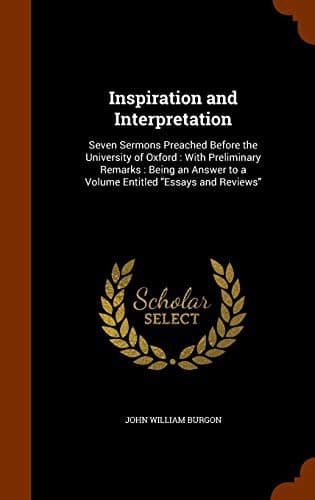
Inspiration and Interpretation: Seven Sermons Preached Before the University of OxfordBurgon, John William
Religion
Inspiration and Interpretation: Seven Sermons Preached Before the University of Oxford
Burgon, John William
Bible -- Criticism, interpretation, etc.; Bible -- Inspiration; Sermons, English
But I shall be told,--with that patronizing air of conscious
intellectual superiority which a certain class of gentlemen habitually
assume on such occasions,--that I mistake the case completely: that no
wish is entertained in any quarter to invalidate the truth of
Revelation, or to shake Men's confidence in the Bible as the Word of
GOD: that it has been the way of narrow-minded bigots in all ages, and
is so in this, to raise an outcry of the Bible being in danger, and so
to rouse the prejudices of mankind: that the error lies in claiming for
the Bible an office which it nowhere claims for itself, and which it was
never meant to fulfil: that the harmony between the Bible and Nature is
complete, but that it is not _such_ a harmony as is sometimes imagined:
that the Bible is not a scientific book, and was never meant to teach
Natural Science: that it was designed to inculcate moral goodness, and
is clearly full of unscientific statements, which it is the office of
Science to correct; and, if need be, to remove. All this, and much
beside, I shall be told. Such fallacious platitudes have been put forth
by men who are neither Divines nor Philosophers, _ad nauseam_, within
the last forty or fifty years.
Now, in reply, we have a few words to say. The profession of
faithfulness we hail with pleasure: the imputation of imbecility we
accept with unconcern. But when gentlemen tell us that the Bible was
never meant to teach Science; and that wherever its statements are
opposed to the clear inductions of reason, they must give way; and so
forth: we take the liberty of retaliating their charge. We inform them
that _they_ really mistake the case entirely. When they go on to tell us
that they believe in the truth of the Bible as sincerely as ourselves:
that its harmonies are complete, but not such as we imagine; and so
forth;--we venture to add that they really know not what they assert. In
plain language, they talk nonsense. Of a simple unbeliever we know at
least what to think. But what is to be thought of persons who disbelieve
just whatever they dislike, and yet profess to be just as hearty
believers as you or I?
Public-domain text, read in full here on John Shaqi.
Reviews
Reviews
No reviews yet
Be the first to share your thoughts on this work.
Elsewhere in the archive
Join the Discussion
Join the discussion
Sign in to leave a comment or review.
Sign InorCreate an account