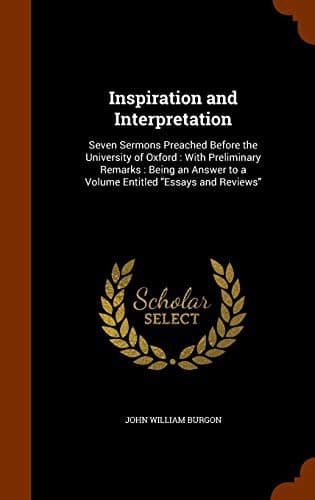
Inspiration and Interpretation: Seven Sermons Preached Before the University of OxfordBurgon, John William
Religion
Inspiration and Interpretation: Seven Sermons Preached Before the University of Oxford
Burgon, John William
Bible -- Criticism, interpretation, etc.; Bible -- Inspiration; Sermons, English
That the Mosaic record of Creation has been thought at variance with
certain deductions of modern observation, is not surprising: seeing that
the deductions of each fresh period have been at variance with the
deductions of that which went before; and seeing that the theory of one
existing school is inconsistent with the theory of another.--That the
Bible is not, in any sense, _a scientific treatise_ again, is simply a
truism: (who ever supposed that it was?). Moses writes "the history of
the Human Race as regards Sin and Salvation: not a cosmical survey of
all the successive phenomena of the globe[306]." Further, that he
employs popular phraseology when speaking of natural phenomena, is a
statement altogether undeniable. But such remarks are a gross fallacy,
and a mere deceit, if it be meant that the statements in the Bible
partake of the imperfection of knowledge incident to a rude and
primitive state of society. To revive an old illustration,--Is a
philosopher therefore a child, because, in addressing children, he uses
language adapted to their age and capacity? GOD speaks in the First
Chapter of Genesis,--_hath_ spoken for three and thirty hundred
years,--as unto children: but there is no risk therefore that in what He
saith, He either hath deceived, or will deceive mankind.
You are never to forget the great fundamental position, that the Bible
claims to be the Word of GOD; and that _GOD'S Word can never contradict
or be contradicted by GOD'S works_. We therefore reject, _in limine_,
all insinuations about the "unscientific" character of the Bible. A
scientific man does not cease to be scientific because he does not
choose always to express himself scientifically. Again. A man of
universal Science does not forfeit his scientific reputation, if, in the
course of a _moral_ or _religious_ argument, his allusions to _natural_
phenomena are expressed in the ordinary language of mankind. Even so,
Almighty God, "in whom are hid all the treasures of wisdom and
knowledge[307],"--speaking to us by the mouth of His holy Prophets,
never, that I am aware, teaches them to speak a strictly scientific
language,--_except when the Science of Theology is being discoursed of_.
On other occasions, He suffers their language to be like yours or mine.
"Sun, stand thou still upon Gibeon[308]:"--"The clouds drop down the
dew[309]:"--"The wind bloweth where it listeth[310]."--Not so when
_Theology_ is the subject. _Then_ the language becomes scientific.
"Except a man be born of water and of the Spirit, he cannot enter into
the Kingdom of GOD[311]:"--"Take, eat, This is My Body[312]:"--"Before
Abraham was, I am[313]:"--"I and the FATHER are One[314]."
Public-domain text, read in full here on John Shaqi.
Reviews
Reviews
No reviews yet
Be the first to share your thoughts on this work.
Elsewhere in the archive
Join the Discussion
Join the discussion
Sign in to leave a comment or review.
Sign InorCreate an account