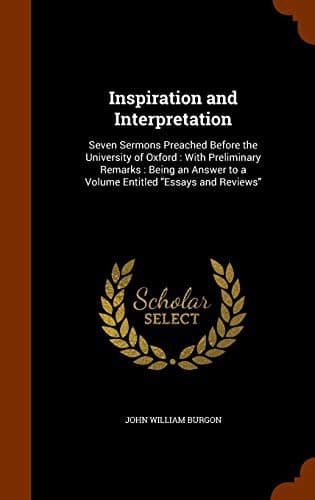
Inspiration and Interpretation: Seven Sermons Preached Before the University of OxfordBurgon, John William
Religion
Inspiration and Interpretation: Seven Sermons Preached Before the University of Oxford
Burgon, John William
Bible -- Criticism, interpretation, etc.; Bible -- Inspiration; Sermons, English
I. INTERPRETATION, then, in the largest sense of the term, I take to
denote the discovery of the method and meaning of Holy Scripture.--I
exclude those critical labours which merely aim at establishing a
correct text.--I exclude also the learning which merely investigates the
grammatical force of single words. True, that even to translate is often
to interpret; but this results only from the imperfection of
language,--which can seldom represent the words of one idiom by the
words of another, without at the same time parting with the
associations which belong to the old words, and importing those which
are inseparable from the new.--Moreover, except occasionally, it is
presumed that the lore of the Antiquary, Geographer, and so forth, does
not aspire to the dignity of Interpretation.--To be brief,--whatever
simply puts us on a level with ordinary hearers of ancient days; does no
more than inform us what custom, locality, or date is intended by the
sacred writer; (things which once were obvious, and which _ought not_ to
be any difficulty now;)--all this, I say, seems external to the province
of Interpretation; the purpose of which is to discover _the method_ and
_the meaning_ of Holy Writ. And I find that every extant specimen of
this sacred Science is either (1) what GOD hath Himself revealed; or
(2) what the Church hath with authority delivered; or (3) what
individuals have thought themselves competent to declare.
Of these three authorities concerning the sense of Scripture, it is
evident that the last-named is entitled to least notice. So unimportant
indeed is it, as scarcely to be of any weight at all. What one
individual asserts, on his own unsupported authority, another individual
may, with as much or as little authority, deny; and _who_ is to decide?
But the authority indicated in the second place, clearly challenges very
different attention. When, for example, our own Hooker declares,
concerning the 5th verse of the iiird chapter of St. John, that "of all
the ancients _there is not one to be named_ that ever did otherwise
expound or allege this place than as implying external Baptism[440]," we
perceive at once that such consent, on the part of men in whose ears the
echoes of the Apostolic Age had not yet quite ceased to vibrate; and
who were themselves professors of that Divine Science which takes
cognizance of the subject-matter in hand:--such general consent of
Antiquity, I say, on a point of Interpretation, must evidently be held
to be decisive.
Public-domain text, read in full here on John Shaqi.
Reviews
Reviews
No reviews yet
Be the first to share your thoughts on this work.
Elsewhere in the archive
Join the Discussion
Join the discussion
Sign in to leave a comment or review.
Sign InorCreate an account