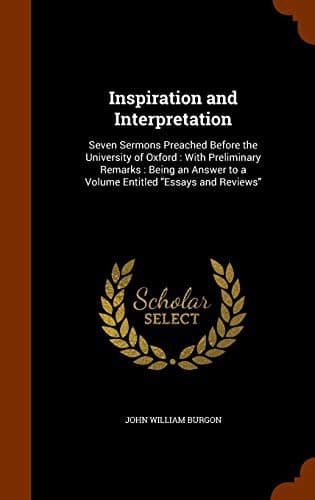
Inspiration and Interpretation: Seven Sermons Preached Before the University of OxfordBurgon, John William
Religion
Inspiration and Interpretation: Seven Sermons Preached Before the University of Oxford
Burgon, John William
Bible -- Criticism, interpretation, etc.; Bible -- Inspiration; Sermons, English
"Religio mihi est, eritque, contra torrentem omnium Patrum, Sanctas
Scripturas interpretari; nisi quando me argumenta cogunt
evidentissima,--quod nunquam eventurum credo[441]." So spake one who had
read the Fathers with no common care, and who turned his reading to no
common account. "I persuade myself," he says, "that you will learn the
modesty of submitting your judgment to that of the Catholic Doctors,
where they are found generally to concur in the interpretation of a text
of Scripture, how absurd soever that interpretation may, at first
appearance, seem to be. For upon a diligent search you will find, that
_aliquid latet quod non patet_,--'there is a mystery in the bottom:' and
that which at first view seemed even ridiculous, will afterwards appear
to be a most certain truth[442]." "No man can oppose Catholic consent,
but he will at last be found to oppose both the Divine Oracles and Sound
Reason[443]."
The distinction thus drawn between individual opinion and the collective
voice of the Church, was far better understood anciently than at
present. The interpretation of a Council, especially if oecumenical,
was accounted decisive. Even the generally consentient voice of Doctors
and Fathers, as far as it could be ascertained, was held to be of the
same authoritative kind. An interesting illustration occurs. Than
Eusebius, Bishop of Cæsarea, few Fathers of the fourth century were more
learned in Holy Scripture. He, commenting upon "the Captain of the
LORD'S Host," mentioned in the vth chapter of the Book of Joshua,
delivers it as his opinion that it was the same Personage who spoke to
Moses 'in the Bush;' viz. the Eternal SON[444]. On which opinion, a
learned man of the same age, in a scholion of singular beauty which has
come down to us, remarks as follows:--"Aye, but the Church, O most holy
Eusebius, holds a view on this subject altogether at variance with
thine[445]." He goes on to allege reasons why the ἀρχιστράτηγος of
Joshua must be held to have been not an _uncreated_, but a _created_
Angel; the Archangel Michael, in fact. We will not now go into that
matter. You are but requested to observe, how profoundly unimportant the
opinion of a very learned individual was held to be, by one in whose
ears the Patristic "torrent" was yet sounding; although Justin Martyr is
known to have been of the same mind with Eusebius.--And thus much for
individual views as to the meaning of Holy Scripture; as contrasted with
the decisions of Councils and Fathers. To judge from the signs of the
Age, we have exactly reversed the ancient estimate; and expect that more
respect will be shewn to our own private fancies, than to a general
consensus of Divines, ancient and modern. It seems to have been
discovered that the supreme guide of Life is the individual
conscience,--"without appeal--except to himself[446]!"
Public-domain text, read in full here on John Shaqi.
Reviews
Reviews
No reviews yet
Be the first to share your thoughts on this work.
Elsewhere in the archive
Join the Discussion
Join the discussion
Sign in to leave a comment or review.
Sign InorCreate an account