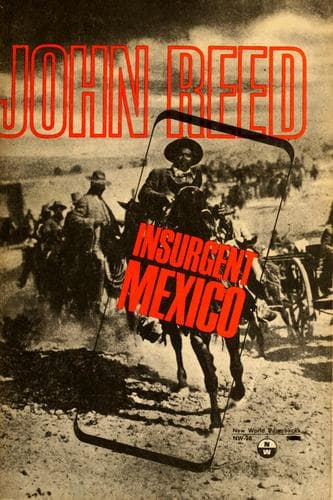
Mexico -- History -- 1910-1946; Mexico -- History -- Revolution, 1910-1920
The Federal shrapnel, well fired and excellently timed, was bursting now
only a few hundred yards in front of our line, and the minute boom of
their guns was almost incessant. Crash—Wheeeeaa! Over our heads,
snapping viciously in the leafy trees, sang the rain of lead. Our guns
replied spasmodically. The home-made shells, fashioned on converted
mining machinery in Chihuahua, were not reliable. Galloped past stout
Captain Marinelli, the Italian soldier of fortune, steering as near the
newspapermen as possible, with a serious, Napoleonic look on his face.
He glanced once or twice at the camera man, smiling graciously, but the
latter coldly looked away. With a workmanlike flourish he ordered the
wheeling of his gun into position and sighted it himself. Just then a
shell burst deafeningly about a hundred yards in front. The Federals
were getting the range. Marinelli bounded away from his cannon, mounted
his horse, limbered up and came galloping dramatically back with his gun
rumbling along at a dead run behind. None of the other guns had
retreated. Puffing up his foaming charger in front of the camera man,
he flung himself to the ground and took a position.
"Now," he said, "you can take my picture!"
"Go to hell," said the camera man, and a great shout of laughter went up
along the line.
The high cracked note of a bugle thrilled through the racking roar.
Immediately mules dragging their jangling limbers appeared, and shouting
men. The caissons snapped shut.
"Going down front," shouted Colonel Servin. "Not hitting. Too far away
here...."
And the long-halted line snapped taut and wound out into the open
desert, under the bursting shells.
*CHAPTER IX*
*BATTLE*
We returned along the winding path through the mesquite, crossed the
torn-up track, and struck out across the dusty plain southeastward.
Looking back along the railroad I could see smoke and the round front of
the first train miles away; and in front of it throngs of active little
dots swarming on the right of way, distorted like things seen in a wavy
mirror. We strode along in a haze of thin dust. The giant mesquite
dwindled until it scarcely reached to our knees. To the right the tall
hill and the chimneys of the town swam tranquilly in the hot sun; rifle
fire had almost ceased for the moment, and only dazzling bursts of thick
white smoke marked our occasional shells along the ridge. We could see
our drab guns rocking down the plain, spreading along the first line of
alamos, where the searching fingers of the enemy’s shrapnel probed
continually. Little bodies of horsemen moved here and there over the
desert, and stragglers on foot, trailing their rifles.
An old peon, stooped with age and dressed in rags, crouched in the low
shrub gathering mesquite twigs.
"Say, friend," we asked him, "is there any way we can get in close to
see the fighting?"
He straightened up and stared at us.
Public-domain text, read in full here on John Shaqi.
Reviews
Reviews
No reviews yet
Be the first to share your thoughts on this work.
Elsewhere in the archive
Join the Discussion
Join the discussion
Sign in to leave a comment or review.
Sign InorCreate an account