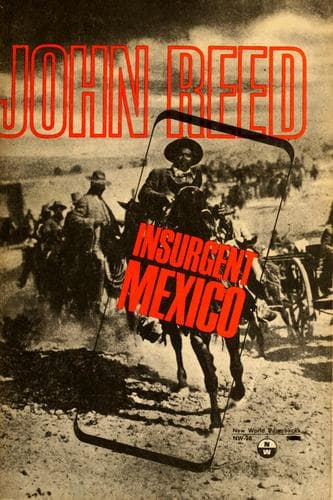
Mexico -- History -- 1910-1946; Mexico -- History -- Revolution, 1910-1920
"If you had been here as long as I have," said he, "you wouldn’t care
about seeing the fighting. _Carramba_! I have seen them take Torreon
seven times in three years. Sometimes they attack from Gomez Palacio
and sometimes from the mountains. But it is always the same—war. There
is something interesting in it for the young, but for us old people, we
are tired of war." He paused and stared out over the plain. "Do you see
this dry ditch? Well, if you will get down in it and follow along it
will lead you into the town." And then, as an afterthought, he added
incuriously, "What party do you belong to?"
"The Constitutionalists."
"So. First it was the Maderistas, and then the Orozquistas, and now
the—what did you call them? I am very old, and I have not long to live;
but this war—it teems to me that all it accomplishes is to let us go
hungry. Go with God, señores." And he bent again to his slow task,
while we descended into the arroyo. It was a disused irrigation ditch
running a little south of west, its bottom covered with dusty weeds, and
the end of its straight length hidden from us by a sort of mirage that
looked like a glaring pool of water. Stooped a little, so as to be
hidden from the outside, we walked along, it seemed, for hours, the
cracked bottom and dusty sides of the ditch reflecting the fierce heat
upon us until we were faint with it. Once horsemen passed quite near on
our right, their big iron spurs ringing; we crouched down until they
passed, for we didn’t want to take any chances. Down in the ditch the
artillery fire sounded very faint and far away, but once I cautiously
lifted my head above the bank and discovered that we were very near the
first line of trees. Shells were bursting along it, and I could even
see the belch of furious haze hurling out from the mouths of our cannon,
and feel the surf of sound-waves hit me like a blow when they fired. We
were a good quarter of a mile in front of our artillery, and evidently
making for the water-tank on the very edge of the town. As we stooped
again the shells passing overhead whined sharply and suddenly across the
arc of sky and were cut off abruptly until the sullen echoless booff! of
their explosion. There ahead, where the railroad trestle of the main
line crossed the arroyo, huddled a little pile of bodies—evidently left
from the first attack. Hardly one was bloody; their heads and hearts
were pierced with the clean, tiny holes of steel Mauser bullets. They
lay limply, with the unearthly calm, lean faces of the dead. Someone,
perhaps their own thrifty _compañeros_, had stripped them of arms,
shoes, hats and serviceable clothing. One sleeping soldier, squatting
on the edge of the heap with his rifle across his knees, snored deeply.
Flies covered him—the dead hummed with them. But the sun had not yet
affected them. Another soldier leaned against the townward bank of the
ditch, his feet resting on a corpse, banging methodically away at
something he saw.
Public-domain text, read in full here on John Shaqi.
Reviews
Reviews
No reviews yet
Be the first to share your thoughts on this work.
Elsewhere in the archive
Join the Discussion
Join the discussion
Sign in to leave a comment or review.
Sign InorCreate an account