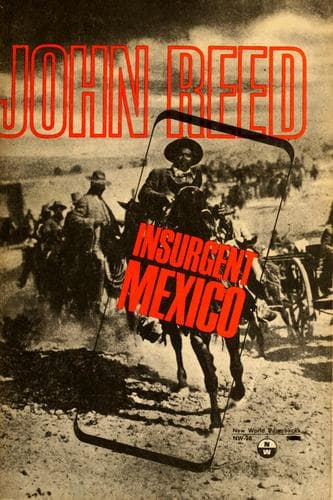
Mexico -- History -- 1910-1946; Mexico -- History -- Revolution, 1910-1920
However, no one was in any hurry, so we sat down also. Appeared then
Catarino Cabrera, the saloon keeper, and also the Constitutionalist
_jefe_ politico of Valle Allegre, very drunk, walking arm in arm with
Don Priciliano Saucedes, the former _jefe_ under the Diaz government.
Don Priciliano is a fine-looking, white-haired old Castilian who used to
lend money to the peons at twenty per cent. Don Catarino is a former
schoolmaster, an ardent Revolutionist—he lends money at a slightly less
rate of usury to the same parties. Don Catarino wears no collar, but he
sports a revolver and two cartridge-belts. Don Priciliano during the
first Revolution was deprived of most of his property by the Maderistas
of the town, and then strapped naked upon his horse and beaten upon his
bare back with the flat of a sword.
"Aie!" he says to my question. "The Revolution! I have most of the
Revolution upon my back!"
And the two pass on to Don Priciliano’s house, where Catarino is
courting a beautiful daughter.
Then, with the thunder of hoofs, dashes up the gay and gallant young
Jesus Triano, who was a Captain under Orozco. But Valle Allegre is a
three days’ ride from the railroad, and politics are not a burning issue
there; so Jesus rides his stolen horse with impunity around the streets.
He is a large young man with shining teeth, a rifle and bandolier, and
leather trousers fastened up the side with buttons as big as dollars—his
spurs are twice as big. They say that his dashing ways and the fact
that he shot Emetario Flores in the back have won him the hand of
Dolores, youngest daughter of Manuel Paredes, the charcoal contractor.
He plunges down the arroyo at a gallop, his horse tossing bloody froth
from the cruel curb.
Captain Adolfo Melendez, of the Constitutionalist army, slouches around
the corner in a new, bottle-green corduroy uniform. He wears a handsome
gilded sword which once belonged to the Knights of Pythias. Adolfo came
to Valle Allegre on a two weeks’ leave, which he prolonged indefinitely
in order to take to himself a wife—the fourteen-year-old daughter of a
village aristocrat. They say that his wedding was magnificent beyond
belief, two priests officiating and the service lasting an hour more
than necessary. But this may have been good economy on Adolfo’s part,
since he already had one wife in Chihuahua, another in Farral, and a
third in Monterey, and, of course, had to placate the parents of the
bride. He had now been away from his regiment three months, and told me
simply that he thought they had forgotten all about him by this time.
At half-past four a thunder of cheers announced the arrival of the small
boy with the steel spurs. It seems that he had got into a card game at
El Oro, and had temporarily forgotten his errand.
Public-domain text, read in full here on John Shaqi.
Reviews
Reviews
No reviews yet
Be the first to share your thoughts on this work.
Elsewhere in the archive
Join the Discussion
Join the discussion
Sign in to leave a comment or review.
Sign InorCreate an account