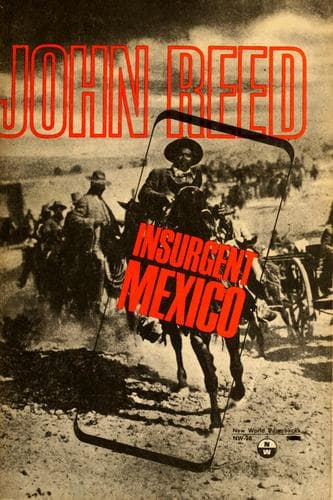
Mexico -- History -- 1910-1946; Mexico -- History -- Revolution, 1910-1920
But, of course, nothing was said about it. He had arrived, which was
the important thing. We formed a wide ring in the open space where the
burros stood, and the two owners began to "throw" their birds. But at
the first onslaught the fowl upon which we had all bet our money spread
its wings, and, to the astonishment of the assembled company, soared
screaming over the mesquite tree and disappeared toward the mountains.
Ten minutes later the two owners unconcernedly divided the proceeds
before our eyes, and we strolled home well content.
Fidencio and I dined at Charlie Chee’s hotel. Throughout Mexico, in
every little town, you will find Chinamen monopolizing the hotel and
restaurant business. Charlie, and his cousin Foo, were both married to
the daughters of respectable Mexican villagers. No one seemed to think
that strange. Mexicans appear to have no race prejudices whatever.
Captain Adolfo, in a bright yellow khaki uniform and another sword,
brought his bride, a faintly pretty brown girl with her hair in a bang,
wearing chandelier lusters as earrings. Charlie banged down in front of
each of us a quart bottle of _aguardiente_, and, sitting down at the
table, flirted politely with Señora Melendez, while Foo served dinner,
enlivened with gay social chatter in pidgin Mexican.
It seemed that there was to be a _baile_ at Don Priciliano’s that
evening, and Charlie politely offered to teach Adolfo’s wife a new step
which he had learned in El Paso, called the Turkey Trot. This he did
until Adolfo began to look sullen and announced that he didn’t think he
would go to Don Priciliano’s, since he considered it a bad thing for
young wives to be seen much in public. Charlie and Foo also tendered
their regrets, because several of their countrymen were due in the
village that evening from Parral, and said that they would, of course,
want to raise a little Chinese hell together.
So Fidencio and I finally departed, after solemnly promising that we
would return in time for the Chinese festivities after the dance.
Outside, strong moonlight flooded all the village. The jumbled roofs
were so many tipped-up silvery planes, and the tree-tops glistened.
Like a frozen cataract the arroyo fell away, and the great valley beyond
lay drowned in rich, soft mist. The life-sounds quickened in the
dark—excited laughter of young girls, a woman catching her breath at a
window to the swift, hot torrent of a man’s speech as he leaned against
the bars, a dozen guitars syncopating each other, a young buck hurrying
to meet his _novia_, spurs ringing clear. It was cold. As we passed
Cabrera’s door a hot, smoky, alcoholic breath smote us. Beyond that you
crossed on stepping-stones the stream where the women wash their
clothes. Climbing the other bank we saw the brilliant windows of Don
Priciliano’s house, and heard the far strains of Valle Allegre’s
orchestra.
Public-domain text, read in full here on John Shaqi.
Reviews
Reviews
No reviews yet
Be the first to share your thoughts on this work.
Elsewhere in the archive
Join the Discussion
Join the discussion
Sign in to leave a comment or review.
Sign InorCreate an account