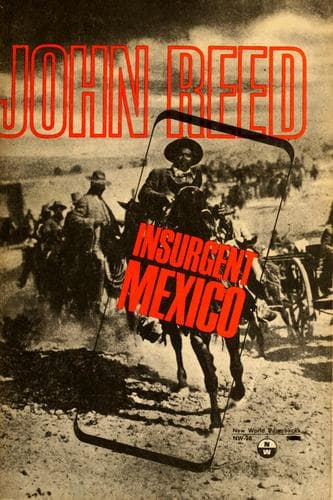
Mexico -- History -- 1910-1946; Mexico -- History -- Revolution, 1910-1920
In El Oro one can still see the ruins of a monastery—they call it now,
vaguely, the Collegio—the pathetic little arched roofs of a row of
monkish cells built of adobe, and now fast crumbling under hot suns and
torrential rains. It partly surrounds what was once the patio of the
cloister, and a great mesquite tree towers there over the forgotten
headstone of an ancient grave, inscribed with the lordly name of Doña
Isabella Guzman. Of course, everybody has entirely forgotten who Doña
Isabella was, or when she died. There still stands in the public square
a fine old Spanish church with a beamed ceiling. And over the door of
the tiny Palacio Municipal is the almost erased carving of the arms of
some ancient Spanish house.
Here is romance for you. But the inhabitants have no respect for
tradition, and hardly any memory of the ancients who left these
monuments. The exuberant Indian civilization has entirely obliterated
all traces of the _conquistadores_.
El Oro is noted as the gayest town of all the mountain region. There
are _bailes_ almost every night, and far and near it is a matter of
common knowledge that El Oro is the home of the prettiest girls in
Durango. In El Oro, too, they celebrate feast days with more ebullience
than in other localities. All the charcoal-burners and goat-herds and
pack-train drivers and ranchers for miles around come there on
holidays,—so that one feast-day generally means two or three without
work, since there must be one day for celebrating, and at least another
for coming and returning home.
And what _Pastorellas_ they have in El Oro! Once a year, on the Feast
of the Santos Reyes, they perform Los Pastores all over this part of the
country. It is an ancient miracle play of the kind that used to take
place all over Europe in the Renaissance,—the kind that gave birth to
Elizabethan drama, and is now extinct everywhere in the world. It is
handed down by word of mouth from mother to daughter, from the remotest
antiquity. It is called "Luzbel," the Spanish for _Lucifer_, and
depicts Perverse Man in the Midst of His Deadly Sin, _Lucifer_, the
Great Antagonist of Souls, and the Everlasting Mercy of God Made Flesh
in the Child Jesus.
In most places there is only one performance of Los Pastores. But in El
Oro there are three or four on the night of the Santos Reyes, and others
at different times of the year, as the spirit moves. The _cura_, or
village priest, still trains the actors. The play takes place no longer
in the church, however. It is added to from generation to generation,
sometimes being twisted to satirize persons in the village. It has
become too profane, too realistic, for the Church; but still it points
the great moral of medieval religion.
Public-domain text, read in full here on John Shaqi.
Reviews
Reviews
No reviews yet
Be the first to share your thoughts on this work.
Elsewhere in the archive
Join the Discussion
Join the discussion
Sign in to leave a comment or review.
Sign InorCreate an account