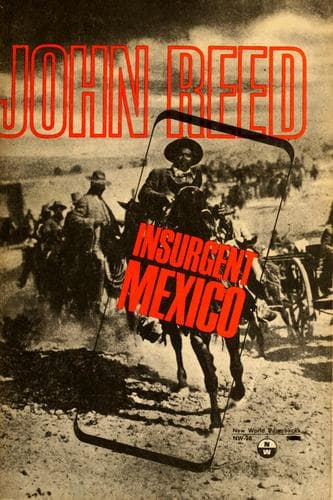
Mexico -- History -- 1910-1946; Mexico -- History -- Revolution, 1910-1920
"_Ca-r-r-r-ai-i_, our friend here wants a horse!" grinned Villa
sarcastically amid a burst of laughter from the others. "Why, you
correspondents will be wanting an automobile next! _Oiga_, señor
reporter, do you know that about a thousand men in my army have no
horses? Here’s the train. What do you want a horse for?"
"So I can ride with the advance."
"No," he smiled. "There are too many _ballasos_—too many bullets flying
in the advance...."
He was hurrying into his clothes as he talked, and gulping coffee from
the side of a dirty tin coffee-pot. Somebody handed him his gold-handled
sword.
"No!" he said contemptuously. "This is to be a fight, not a parade.
Give me my rifle!"
He stood at the door of his caboose for a moment, thoughtfully looking
at the long lines of mounted men, picturesque in their crossed
cartridge-belts and varied equipment. Then he gave a few quick orders
and mounted his big stallion.
"_Vamonos!_" cried Villa. The bugles brayed and a subdued silver
clicking ringing sounded as the companies wheeled and trotted southward
in the dust....
And so the army disappeared. During the day we thought we heard
cannonading from the southwest, where Urbina was reported to be coming
down from the mountains to attack Mapimi. And late in the afternoon
news came of the capture of Bermejillo, and a courier from Benavides
said that he had taken Tlahualilo.
We were in a fever of impatience to be off. About sundown Señor Calzado
remarked that the repair train would leave in an hour, so I grabbed a
blanket and walked a mile up the line of trains to it.
*CHAPTER IV*
*ON THE CANNON-CAR*
The first car of the repair train was a steel-encased flat-car, upon
which was mounted the famous Constitutionalist cannon "El Niño," with an
open caisson full of shells behind it. Behind that was an armored car
full of soldiers, then a car of steel rails, and four loaded with
railroad ties. The engine came next, the engineer and fireman hung with
cartridge-belts, their rifles handy. Then followed two or three
box-cars full of soldiers and their women. It was a dangerous business.
A large force of Federals were known to be in Mapimi, and the country
swarmed with their outposts. Our army was already far ahead, except for
five hundred men who guarded the trains at Conejos. If the enemy could
capture or wreck the repair train the army would be cut off without
water, food or ammunition. In the darkness we moved out. I sat upon
the breech of "El Niño," chatting with Captain Diaz, the commander of
the gun, as he oiled the breech lock of his beloved cannon and curled
his vertical mustachios. In the armored recess behind the gun, where
the Captain slept, I heard a curious, subdued rustling noise.
"What’s that?"
"Eh?" cried he nervously. "Oh, nothing, nothing!"
Public-domain text, read in full here on John Shaqi.
Reviews
Reviews
No reviews yet
Be the first to share your thoughts on this work.
Elsewhere in the archive
Join the Discussion
Join the discussion
Sign in to leave a comment or review.
Sign InorCreate an account