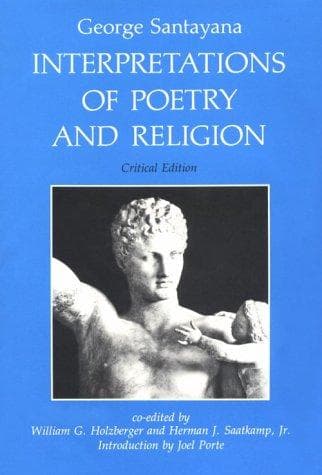
Interpretations of Poetry and Religion — John Shaqi
Interpretations of Poetry and ReligionSantayana, George
Religion
Interpretations of Poetry and Religion
Santayana, George
Aesthetics; Literature -- History and criticism; Poetry; Religion
INTERPRETATIONS
OF
POETRY AND RELIGION
BY
GEORGE SANTAYANA
NEW YORK
CHARLES SCRIBNER'S SONS
1900
PREFACE
The following volume is composed of a number of papers written at
various times and already partially printed; they are now revised and
gathered together in the hope that they may lead the reader, from
somewhat different points of approach, to a single idea. This idea is
that religion and poetry are identical in essence, and differ merely
in the way in which they are attached to practical affairs. Poetry
is called religion when it intervenes in life, and religion, when it
merely supervenes upon life, is seen to be nothing but poetry.
It would naturally follow from this conception that religious doctrines
would do well to withdraw their pretension to be dealing with matters
of fact. That pretension is not only the source of the conflicts of
religion with science and of the vain and bitter controversies of
sects; it is also the cause of the impurity and incoherence of religion
in the soul, when it seeks its sanctions in the sphere of reality,
and forgets that its proper concern is to express the ideal. For the
dignity of religion, like that of poetry and of every moral ideal, lies
precisely in its ideal adequacy, in its fit rendering of the meanings
and values of life, in its anticipation of perfection; so that the
excellence of religion is due to an idealization of experience which,
while making religion noble if treated as poetry, makes it necessarily
false if treated as science. Its function is rather to draw from
reality materials for an image of that ideal to which reality ought
to conform, and to make us citizens, by anticipation, in the world we
crave.
It also follows from our general conception that poetry has a universal
and a moral function. Its rudimentary essays in the region of fancy
and pleasant sound, as well as its idealization of episodes in human
existence, are only partial exercises in an art that has all time and
all experience for its natural subject-matter and all the possibilities
of being for its ultimate theme. As religion is deflected from its
course when it is confused with a record of facts or of natural laws,
so poetry is arrested in its development if it remains an unmeaning
play of fancy without relevance to the ideals and purposes of life. In
that relevance lies its highest power. As its elementary pleasantness
comes from its response to the demands of the ear, so its deepest
beauty comes from its response to the ultimate demands of the soul.
Public-domain text, read in full here on John Shaqi.
Reviews
Reviews
No reviews yet
Be the first to share your thoughts on this work.
Join the Discussion
Join the discussion
Sign in to leave a comment or review.
Sign InorCreate an account