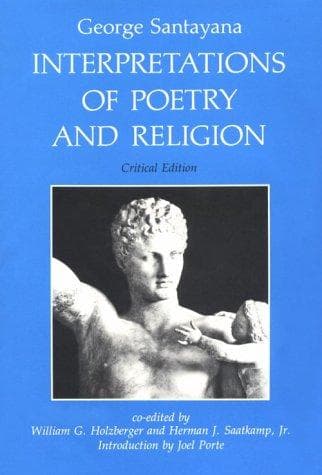
Interpretations of Poetry and ReligionSantayana, George
Religion
Interpretations of Poetry and Religion
Santayana, George
Aesthetics; Literature -- History and criticism; Poetry; Religion
It is thus that the imagination of our time has relapsed into
barbarism. But discipline of the heart and fancy is always so rare
a thing that the neglect of it need not be supposed to involve any
very terrible or obvious loss. The triumphs of reason have been few
and partial at any time, and perfect works of art are almost unknown.
The failure of art and reason, because their principle is ignored, is
therefore hardly more conspicuous than it was when their principle,
although perhaps acknowledged, was misunderstood or disobeyed. Indeed,
to one who fixes his eye on the ideal goal, the greatest art often
seems the greatest failure, because it alone reminds him of what it
should have been. Trivial stimulations coming from vulgar objects, on
the contrary, by making us forget altogether the possibility of a deep
satisfaction, often succeed in interesting and in winning applause.
The pleasure they give us is so brief and superficial that the wave of
essential disappointment which would ultimately drown it has not time
to rise from the heart.
The poetry of barbarism is not without its charm. It can play with
sense and passion the more readily and freely in that it does not
aspire to subordinate them to a clear thought or a tenable attitude of
the will. It can impart the transitive emotions which it expresses; it
can find many partial harmonies of mood and fancy; it can, by virtue
of its red-hot irrationality, utter wilder cries, surrender itself
and us to more absolute passion, and heap up a more indiscriminate
wealth of images than belong to poets of seasoned experience or of
heavenly inspiration. Irrational stimulation may tire us in the end,
but it excites us in the beginning; and how many conventional poets,
tender and prolix, have there not been, who tire us now without ever
having excited anybody? The power to stimulate is the beginning of
greatness, and when the barbarous poet has genius, as he well may
have, he stimulates all the more powerfully on account of the crudity
of his methods and the recklessness of his emotions. The defects
of such art--lack of distinction, absence of beauty, confusion of
ideas, incapacity permanently to please--will hardly be felt by the
contemporary public, if once its attention is arrested; for no poet
is so undisciplined that he will not find many readers, if he finds
readers at all, less disciplined than himself.
Public-domain text, read in full here on John Shaqi.
Reviews
Reviews
No reviews yet
Be the first to share your thoughts on this work.
Elsewhere in the archive
Join the Discussion
Join the discussion
Sign in to leave a comment or review.
Sign InorCreate an account