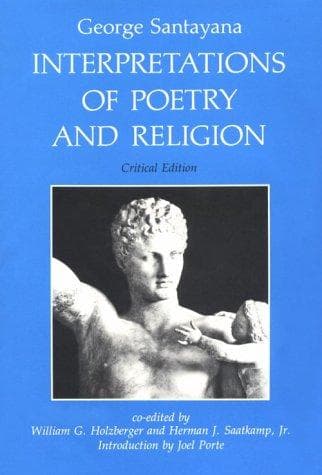
Interpretations of Poetry and ReligionSantayana, George
Religion
Interpretations of Poetry and Religion
Santayana, George
Aesthetics; Literature -- History and criticism; Poetry; Religion
Now the habit of regarding the past as effete and as merely a
stepping-stone to something present or future, is unfavourable to any
true apprehension of that element in the past which was vital and which
remains eternal. It is a habit of thought that destroys the sense of
the moral identity of all ages, by virtue of its very insistence on the
mechanical derivation of one age from another. Existences that cause
one another exclude one another; each is alien to the rest inasmuch as
it is the product of new and different conditions. Ideas that cause
nothing unite all things by giving them a common point of reference and
a single standard of value.
The classic and the Christian systems were both systems of ideas,
attempts to seize the eternal morphology of reality and describe
its unchanging constitution. The imagination was summoned thereby
to contemplate the highest objects, and the essence of things
being thus described, their insignificant variations could retain
little importance and the study of these variations might well seem
superficial. Mechanical science, the science of causes, was accordingly
neglected, while the science of values, with the arts that express
these values, was exclusively pursued. The reverse has now occurred
and the spirit of life, innocent of any rationalizing discipline
and deprived of an authoritative and adequate method of expression,
has relapsed into miscellaneous and shallow exuberance. Religion
and art have become short-winded. They have forgotten the old maxim
that we should copy in order to be copied and remember in order to
be remembered. It is true that the multiplicity of these incompetent
efforts seems to many a compensation for their ill success, or even a
ground for asserting their absolute superiority. Incompetence, when
it flatters the passions, can always find a greater incompetence to
approve of it. Indeed, some people would have regarded the Tower of
Babel as the best academy of eloquence on account of the variety of
oratorical methods prevailing there.
Public-domain text, read in full here on John Shaqi.
Reviews
Reviews
No reviews yet
Be the first to share your thoughts on this work.
Elsewhere in the archive
Join the Discussion
Join the discussion
Sign in to leave a comment or review.
Sign InorCreate an account