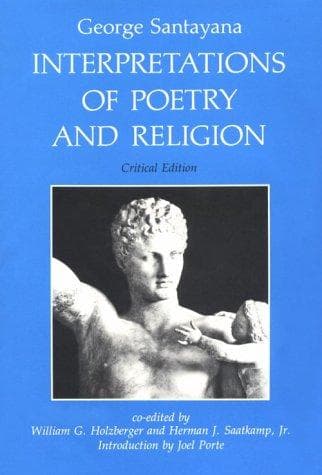
Interpretations of Poetry and ReligionSantayana, George
Religion
Interpretations of Poetry and Religion
Santayana, George
Aesthetics; Literature -- History and criticism; Poetry; Religion
His parents were farmers in central Long Island and his early years
were spent in that district. The family seems to have been not too
prosperous and somewhat nomadic; Whitman himself drifted through
boyhood without much guidance. We find him now at school, now helping
the labourers at the farms, now wandering along the beaches of Long
Island, finally at Brooklyn working in an apparently desultory way as
a printer and sometimes as a writer for a local newspaper. He must
have read or heard something, at this early period, of the English
classics; his style often betrays the deep effect made upon him by the
grandiloquence of the Bible, of Shakespeare, and of Milton. But his
chief interest, if we may trust his account, was already in his own
sensations. The aspects of Nature, the forms and habits of animals,
the sights of cities, the movement and talk of common people, were his
constant delight. His mind was flooded with these images, keenly felt
and afterward to be vividly rendered with bold strokes of realism and
imagination.
Many poets have had this faculty to seize the elementary aspects of
things, but none has had it so exclusively; with Whitman the surface
is absolutely all and the underlying structure is without interest and
almost without existence. He had had no education and his natural
delight in imbibing sensations had not been trained to the uses of
practical or theoretical intelligence. He basked in the sunshine of
perception and wallowed in the stream of his own sensibility, as later
at Camden in the shallows of his favourite brook. Even during the civil
war, when he heard the drum-taps so clearly, he could only gaze at the
picturesque and terrible aspects of the struggle, and linger among the
wounded day after day with a canine devotion; he could not be aroused
either to clear thought or to positive action. So also in his poems; a
multiplicity of images pass before him and he yields himself to each
in turn with absolute passivity. The world has no inside; it is a
phantasmagoria of continuous visions, vivid, impressive, but monotonous
and hard to distinguish in memory, like the waves of the sea or the
decorations of some barbarous temple, sublime only by the infinite
aggregation of parts.
Public-domain text, read in full here on John Shaqi.
Reviews
Reviews
No reviews yet
Be the first to share your thoughts on this work.
Elsewhere in the archive
Join the Discussion
Join the discussion
Sign in to leave a comment or review.
Sign InorCreate an account