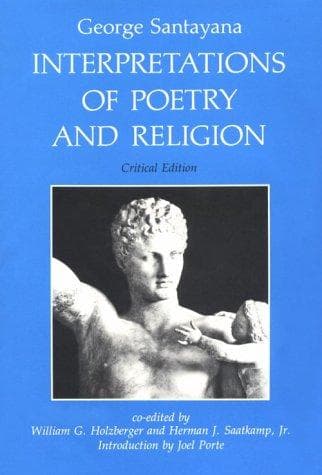
Interpretations of Poetry and ReligionSantayana, George
Religion
Interpretations of Poetry and Religion
Santayana, George
Aesthetics; Literature -- History and criticism; Poetry; Religion
This abundance of detail without organization, this wealth of
perception without intelligence and of imagination without taste, makes
the singularity of Whitman's genius. Full of sympathy and receptivity,
with a wonderful gift of graphic characterization and an occasional
rare grandeur of diction, he fills us with a sense of the individuality
and the universality of what he describes--it is a drop in itself yet a
drop in the ocean. The absence of any principle of selection or of a
sustained style enables him to render aspects of things and of emotion
which would have eluded a trained writer. He is, therefore, interesting
even where he is grotesque or perverse. He has accomplished, by the
sacrifice of almost every other good quality, something never so well
done before. He has approached common life without bringing in his
mind any higher standard by which to criticise it; he has seen it,
not in contrast with an ideal, but as the expression of forces more
indeterminate and elementary than itself; and the vulgar, in this
cosmic setting, has appeared to him sublime.
There is clearly some analogy between a mass of images without
structure and the notion of an absolute democracy. Whitman, inclined
by his genius and habits to see life without relief or organization,
believed that his inclination in this respect corresponded with the
spirit of his age and country, and that Nature and society, at least
in the United States, were constituted after the fashion of his own
mind. Being the poet of the average man, he wished, all men to be
specimens of that average, and being the poet of a fluid Nature, he
believed that Nature was or should be a formless flux. This personal
bias of Whitman's was further encouraged by the actual absence of
distinction in his immediate environment. Surrounded by ugly things
and common people, he felt himself happy, ecstatic, overflowing with a
kind of patriarchal love. He accordingly came to think that there was
a spirit of the New World which he embodied, and which was in complete
opposition to that of the Old, and that a literature upon novel
principles was needed to express and strengthen this American spirit.
Public-domain text, read in full here on John Shaqi.
Reviews
Reviews
No reviews yet
Be the first to share your thoughts on this work.
Elsewhere in the archive
Join the Discussion
Join the discussion
Sign in to leave a comment or review.
Sign InorCreate an account