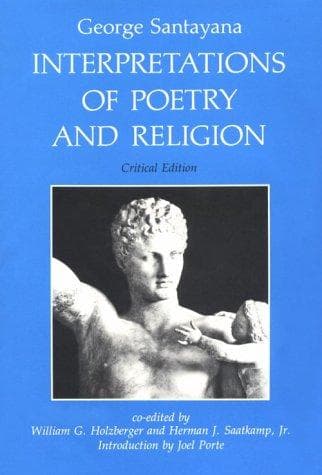
Interpretations of Poetry and ReligionSantayana, George
Religion
Interpretations of Poetry and Religion
Santayana, George
Aesthetics; Literature -- History and criticism; Poetry; Religion
"She thinks there was more cause
In love of power, high fame, pure loyalty?
Perhaps she fancies men wear out their lives
Chasing such shades....
I worked because I want you with my soul."
Readers of the fifth chapter of this volume need not be reminded here
of the contrast which this method of understanding love offers to that
adopted by the real masters of passion and imagination. They began with
that crude emotion with which Browning ends; they lived it down, they
exalted it by thought, they extracted the pure gold of it in a long
purgation of discipline and suffering. The fierce paroxysm which for
him is heaven, was for them the proof that heaven cannot be found on
earth, that the value of experience is not in experience itself but
in the ideals which it reveals. The intense, voluminous emotion, the
sudden, overwhelming self-surrender in which he rests was for them
the starting-point of a life of rational worship, of an austere and
impersonal religion, by which the fire of love, kindled for a moment by
the sight of some creature, was put, as it were, into a censer, to burn
incense before every image of the Highest Good. Thus love ceased to be
a passion and became the energy of contemplation: it diffused over the
universe, natural and ideal, that light of tenderness and that faculty
of worship which the passion of love often is first to quicken in a
man's breast.
Of this art, recommended by Plato and practised in the Christian Church
by all adepts of the spiritual life, Browning knew absolutely nothing.
About the object of love he had no misgivings. What could the object
be except somebody or other? The important thing was to love intensely
and to love often. He remained in the phenomenal sphere: he was a lover
of experience; the ideal did not exist for him. No conception could be
farther from his thought than the essential conception of any rational
philosophy, namely, that feeling is to be treated as raw material
for thought, and that the destiny of emotion is to pass into objects
which shall contain all its value while losing all its formlessness.
This transformation of sense and emotion into objects agreeable to
the intellect, into clear ideas and beautiful things, is the natural
work of reason; when it has been accomplished very imperfectly, or not
at all, we have a barbarous mind, a mind full of chaotic sensations,
objectless passions, and undigested ideas. Such a mind Browning's was,
to a degree remarkable in one with so rich a heritage of civilization.
Public-domain text, read in full here on John Shaqi.
Reviews
Reviews
No reviews yet
Be the first to share your thoughts on this work.
Elsewhere in the archive
Join the Discussion
Join the discussion
Sign in to leave a comment or review.
Sign InorCreate an account