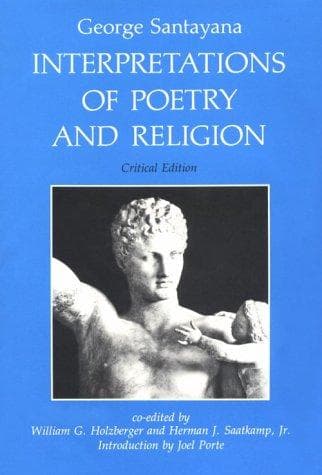
Interpretations of Poetry and ReligionSantayana, George
Religion
Interpretations of Poetry and Religion
Santayana, George
Aesthetics; Literature -- History and criticism; Poetry; Religion
The nineteenth century, as we have already said, has nourished the hope
of abolishing the past as a force while it studies it as an object; and
Browning, with his fondness for a historical stage setting and for the
gossip of history, rebelled equally against the Pagan and the Christian
discipline. The "Soul" which he trusted in was the barbarous soul,
the "Spontaneous Me" of his half-brother Whitman. It was a restless
personal impulse, conscious of obscure depths within itself which it
fancied to be infinite, and of a certain vague sympathy with wind and
cloud and with the universal mutation. It was the soul that might have
animated Attila and Alaric when they came down into Italy, a soul not
incurious of the tawdriness and corruption of the strange civilization
it beheld, but incapable of understanding its original spirit; a soul
maintaining in the presence of that noble, unappreciated ruin all its
own lordliness and energy, and all its native vulgarity.
Browning, who had not had the education traditional in his own country,
used to say that Italy had been his university. But it was a school for
which he was ill prepared, and he did not sit under its best teachers.
For the superficial ferment, the worldly passions, and the crimes of
the Italian Renaissance he had a keen interest and intelligence. But
Italy has been always a civilized country, and beneath the trappings
and suits of civilization which at that particular time it flaunted
so gayly, it preserved a civilized heart to which Browning's insight
could never penetrate. There subsisted in the best minds a trained
imagination and a cogent ideal of virtue. Italy had a religion, and
that religion permeated all its life, and was the background without
which even its secular art and secular passions would not be truly
intelligible. The most commanding and representative, the deepest and
most appealing of Italian natures are permeated with this religious
inspiration. A Saint Francis, a Dante, a Michael Angelo, breathe hardly
anything else. Yet for Browning these men and what they represented
may be said not to have existed. He saw, he studied, and he painted a
decapitated Italy. His vision could not mount so high as her head.
Public-domain text, read in full here on John Shaqi.
Reviews
Reviews
No reviews yet
Be the first to share your thoughts on this work.
Elsewhere in the archive
Join the Discussion
Join the discussion
Sign in to leave a comment or review.
Sign InorCreate an account