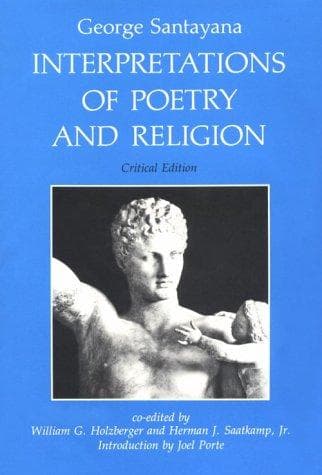
Interpretations of Poetry and ReligionSantayana, George
Religion
Interpretations of Poetry and Religion
Santayana, George
Aesthetics; Literature -- History and criticism; Poetry; Religion
This ideal Browning never disentangles. For him the crude experience is
the only end, the endless struggle the only ideal, and the perturbed
"Soul" the only organon of truth. The arrest of his intelligence at
this point, before it has envisaged any rational object, explains the
arrest of his dramatic art at soliloquy. His immersion in the forms of
self-consciousness prevents him from dramatizing the real relations
of men and their thinkings to one another, to Nature, and to destiny.
For in order to do so he would have had to view his characters from
above (as Cervantes did, for instance), and to see them not merely
as they appeared to themselves, but as they appear to reason. This
higher attitude, however, was not only beyond Browning's scope, it
was positively contrary to his inspiration. Had he reached it, he
would no longer have seen the universe through the "Soul," but through
the intellect, and he would not have been able to cry, "How the
world is made for each one of us!" On the contrary, the "Soul" would
have figured only in its true conditions, in all its ignorance and
dependence, and also in its essential teachableness, a point against
which Browning's barbaric wilfulness particularly rebelled. Booted
in his persuasion that the soul is essentially omnipotent and that
to live hard can never be to live wrong, he remained fascinated by
the march and method of self-consciousness, and never allowed himself
to be weaned from that romantic fatuity by the energy of rational
imagination, which prompts us not to regard our ideas as mere filling
of a dream, but rather to build on them the conception of permanent
objects and overruling principles, such as Nature, society, and the
other ideals of reason. A full-grown imagination deals with these
things, which do not obey the laws of psychological progression, and
cannot be described by the methods of soliloquy.
Public-domain text, read in full here on John Shaqi.
Reviews
Reviews
No reviews yet
Be the first to share your thoughts on this work.
Elsewhere in the archive
Join the Discussion
Join the discussion
Sign in to leave a comment or review.
Sign InorCreate an account