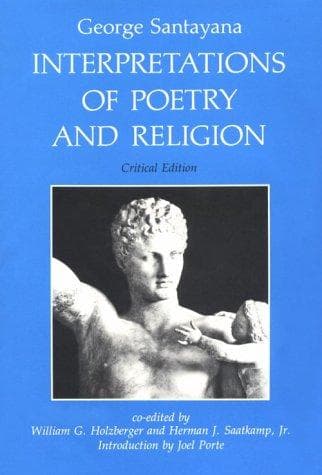
Interpretations of Poetry and ReligionSantayana, George
Religion
Interpretations of Poetry and Religion
Santayana, George
Aesthetics; Literature -- History and criticism; Poetry; Religion
We thus see that Browning's sphere, though more subtle and complex
than Whitman's, was still elementary. It lay far below the spheres of
social and historical reality in which Shakespeare moved; far below
the comprehensive and cosmic sphere of every great epic poet. Browning
did not even reach the intellectual plane of such contemporary poets
as Tennyson and Matthew Arnold, who, whatever may be thought of their
powers, did not study consciousness for itself, but for the sake of
its meaning and of the objects which it revealed. The best things that
come into a man's consciousness are the things that take him out of
it--the rational things that are independent of his personal perception
and of his personal existence. These he approaches with his reason,
and they, in the same measure, endow him with their immortality. But
precisely these things--the objects of science and of the constructive
imagination--Browning always saw askance, in the out-skirts of his
field of vision, for his eye was fixed and riveted on the soliloquizing
Soul. And this Soul being, to his apprehension, irrational, did not
give itself over to those permanent objects which might otherwise have
occupied it, but ruminated on its own accidental emotions, on its
love-affairs, and on its hopes of going on so ruminating for ever.
The pathology of the human mind--for the normal, too, is pathological
when it is not referred to the ideal--the pathology of the human
mind is a very interesting subject, demanding great gifts and great
ingenuity in its treatment. Browning ministers to this interest, and
possesses this ingenuity and these gifts. More than any other poet he
keeps a kind of speculation alive in the now large body of sentimental,
eager-minded people, who no longer can find in a definite religion a
form and language for their imaginative life. That this service is
greatly appreciated speaks well for the ineradicable tendency in man to
study himself and his destiny. We do not deny the achievement when we
point out its nature and limitations. It does not cease to be something
because it is taken to be more than it is.
Public-domain text, read in full here on John Shaqi.
Reviews
Reviews
No reviews yet
Be the first to share your thoughts on this work.
Elsewhere in the archive
Join the Discussion
Join the discussion
Sign in to leave a comment or review.
Sign InorCreate an account