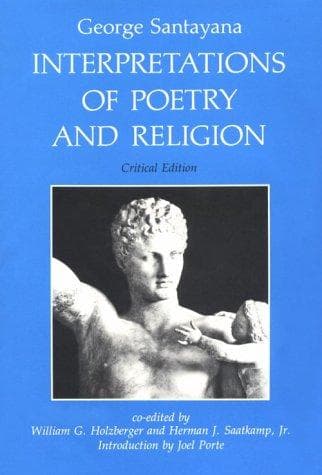
Interpretations of Poetry and ReligionSantayana, George
Religion
Interpretations of Poetry and Religion
Santayana, George
Aesthetics; Literature -- History and criticism; Poetry; Religion
The source of his power lay not in his doctrine, but in his
temperament, and the rare quality of his wisdom was due less to his
reason than to his imagination. Reality eluded him; he had neither
diligence nor constancy enough to master and possess it; but his mind
was open to all philosophic influences, from whatever quarter they
might blow; the lessons of science and the hints of poetry worked
themselves out in him to a free and personal religion. He differed from
the plodding many, not in knowing things better, but in having more
ways of knowing them. His grasp was not particularly firm, he was far
from being, like a Plato or an Aristotle, past master in the art and
the science of life. But his mind was endowed with unusual plasticity,
with unusual spontaneity and liberty of movement--it was a fairyland
of thoughts and fancies. He was like a young god making experiments in
creation: he blotched the work, and always began again on a new and
better plan. Every day he said, "Let there be light," and every day the
light was new. His sun, like that of Heraclitus, was different every
morning.
What seemed, then, to the more earnest and less critical of his
hearers a revelation from above was in truth rather an insurrection
from beneath, a shaking loose from convention, a disintegration of
the normal categories of reason in favour of various imaginative
principles, on which the world might have been built, if it had been
built differently. This gift of revolutionary thinking allowed new
aspects, hints of wider laws, premonitions of unthought of fundamental
unities to spring constantly into view. But such visions were
necessarily fleeting, because the human mind had long before settled
its grammar, and discovered, after much groping and many defeats, the
general forms in which experience will allow itself to be stated. These
general forms are the principles of common sense and positive science,
no less imaginative in their origin than those notions which we now
call transcendental, but grown prosaic, like the metaphors of common
speech, by dint of repetition.
Public-domain text, read in full here on John Shaqi.
Reviews
Reviews
No reviews yet
Be the first to share your thoughts on this work.
Elsewhere in the archive
Join the Discussion
Join the discussion
Sign in to leave a comment or review.
Sign InorCreate an account