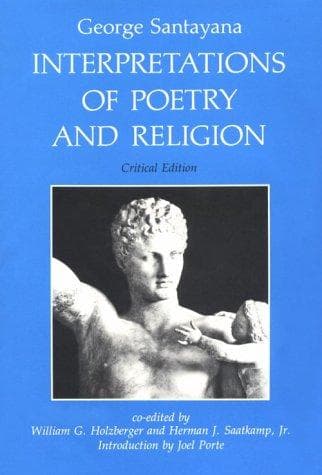
Interpretations of Poetry and ReligionSantayana, George
Religion
Interpretations of Poetry and Religion
Santayana, George
Aesthetics; Literature -- History and criticism; Poetry; Religion
Those who knew Emerson, or who stood so near to his time and to his
circle that they caught some echo of his personal influence, did
not judge him merely as a poet or philosopher, nor identify his
efficacy with that of his writings. His friends and neighbours, the
congregations he preached to in his younger days, the audiences that
afterward listened to his lectures, all agreed in a veneration for his
person which had nothing to do with their understanding or acceptance
of his opinions. They flocked to him and listened to his word, not
so much for the sake of its absolute meaning as for the atmosphere
of candour, purity, and serenity that hung about it, as about a sort
of sacred music. They felt themselves in the presence of a rare and
beautiful spirit, who was in communion with a higher world. More than
the truth his teaching might express, they valued the sense it gave
them of a truth that was inexpressible. They became aware, if we may
say so, of the ultra-violet rays of his spectrum, of the inaudible
highest notes of his gamut, too pure and thin for common ears.
This effect was by no means due to the possession on the part of
Emerson of the secret of the universe, or even of a definite conception
of ultimate truth. He was not a prophet who had once for all climbed
his Sinai or his Tabor, and having there beheld the transfigured
reality, descended again to make authoritative report of it to the
world. Far from it. At bottom he had no doctrine at all. The deeper he
went and the more he tried to grapple with fundamental conceptions,
the vaguer and more elusive they became in his hands. Did he know what
he meant by Spirit or the "Over-Soul"? Could he say what he understood
by the terms, so constantly on his lips, Nature, Law, God, Benefit, or
Beauty? He could not, and the consciousness of that incapacity was so
lively within him that he never attempted to give articulation to his
philosophy. His finer instinct kept him from doing that violence to his
inspiration.
Public-domain text, read in full here on John Shaqi.
Reviews
Reviews
No reviews yet
Be the first to share your thoughts on this work.
Elsewhere in the archive
Join the Discussion
Join the discussion
Sign in to leave a comment or review.
Sign InorCreate an account