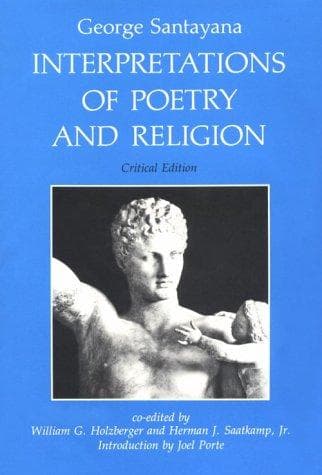
Interpretations of Poetry and ReligionSantayana, George
Religion
Interpretations of Poetry and Religion
Santayana, George
Aesthetics; Literature -- History and criticism; Poetry; Religion
His was not a philosophy passing into a
religion, but a religion expressing itself as a philosophy and veiled,
as at its setting it descended the heavens, in various tints of poetry
and science.
If we ask ourselves what was Emerson's relation to the scientific and
religious movements of his time, and what place he may claim in the
history of opinion, we must answer that he belonged very little to the
past, very little to the present, and almost wholly to that abstract
sphere into which mystical or philosophic aspiration has carried a few
men in all ages. The religious tradition in which he was reared was
that of Puritanism, but of a Puritanism which, retaining its moral
intensity and metaphysical abstraction, had minimized its doctrinal
expression and become Unitarian. Emerson was indeed the Psyche of
Puritanism, "the latest-born and fairest vision far" of all that "faded
hierarchy." A Puritan whose religion was all poetry, a poet whose
only pleasure was thought, he showed in his life and personality the
meagreness, the constraint, the frigid and conscious consecration which
belonged to his clerical ancestors, while his inmost impersonal spirit
ranged abroad over the fields of history and Nature, gathering what
ideas it might, and singing its little snatches of inspired song.
The traditional element was thus rather an external and unessential
contribution to Emerson's mind; he had the professional tinge, the
decorum, the distinction of an old-fashioned divine; he had also the
habit of writing sermons, and he had the national pride and hope of a
religious people that felt itself providentially chosen to establish a
free and godly commonwealth in a new world. For the rest, he separated
himself from the ancient creed of the community with a sense rather of
relief than of regret. A literal belief in Christian doctrines repelled
him as unspiritual, as manifesting no understanding of the meaning
which, as allegories, those doctrines might have to a philosophic and
poetical spirit. Although as a clergy-man he was at first in the habit
of referring to the Bible and its lessons as to a supreme authority, he
had no instinctive sympathy with the inspiration of either the Old or
the New Testament; in Hafiz or Plutarch, in Plato or Shakespeare, he
found more congenial stuff.
Public-domain text, read in full here on John Shaqi.
Reviews
Reviews
No reviews yet
Be the first to share your thoughts on this work.
Elsewhere in the archive
Join the Discussion
Join the discussion
Sign in to leave a comment or review.
Sign InorCreate an account