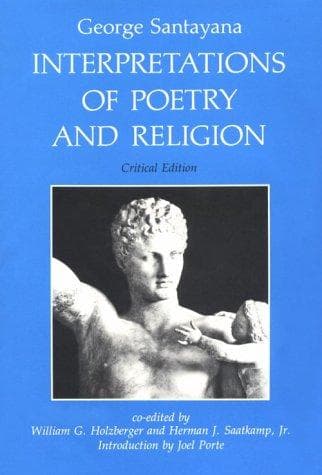
Interpretations of Poetry and ReligionSantayana, George
Religion
Interpretations of Poetry and Religion
Santayana, George
Aesthetics; Literature -- History and criticism; Poetry; Religion
Two forces may be said to have carried Emerson in this mystical
direction; one, that freedom of his imagination which we have already
noted, and which kept him from the fear of self-contradiction; the
other the habit of worship inherited from his clerical ancestors and
enforced by his religious education. The spirit of conformity, the
unction, the loyalty even unto death inspired by the religion of
Jehovah, were dispositions acquired by too long a discipline and rooted
in too many forms of speech, of thought, and of worship for a man like
Emerson, who had felt their full force, ever to be able to lose them.
The evolutions of his abstract opinions left that habit unchanged.
Unless we keep this circumstance in mind, we shall not be able to
understand the kind of elation and sacred joy, so characteristic of
his eloquence, with which he propounds laws of Nature and aspects of
experience which, viewed in themselves, afford but an equivocal support
to moral enthusiasm. An optimism so persistent and unclouded as his
will seem at variance with the description he himself gives of human
life, a description coloured by a poetic idealism, but hardly by an
optimistic bias.
We must remember, therefore, that this optimism is a pious tradition,
originally justified by the belief in a personal God and in a
providential government of affairs for the ultimate and positive good
of the elect, and that the habit of worship survived in Emerson as an
instinct after those positive beliefs had faded into a recognition
of "spiritual laws." We must remember that Calvinism had known how
to combine an awestruck devotion to the Supreme Being with no very
roseate picture of the destinies of mankind, and for more than two
hundred years had been breeding in the stock from which Emerson came
a willingness to be, as the phrase is, "damned for the glory of God."
What wonder, then, that when, for the former inexorable dispensation
of Providence, Emerson substituted his general spiritual and natural
laws, he should not have felt the spirit of worship fail within him?
On the contrary, his thought moved in the presence of moral harmonies
which seemed to him truer, more beautiful, and more beneficent than
those of the old theology. An independent philosopher would not have
seen in those harmonies an object of worship or a sufficient basis
for optimism. But he was not an independent philosopher, in spite
of his belief in independence. He inherited the problems and the
preoccupations of the theology from which he started, being in this
respect like the German idealists, who, with all their pretence of
absolute metaphysics, were in reality only giving elusive and abstract
forms to traditional theology. Emerson, too, was not primarily a
philosopher, but a Puritan mystic with a poetic fancy and a gift for
observation and epigram, and he saw in the laws of Nature, idealized by
his imagination, only a more intelligible form of the divinity he had
always recognized and adored.
Public-domain text, read in full here on John Shaqi.
Reviews
Reviews
No reviews yet
Be the first to share your thoughts on this work.
Elsewhere in the archive
Join the Discussion
Join the discussion
Sign in to leave a comment or review.
Sign InorCreate an account