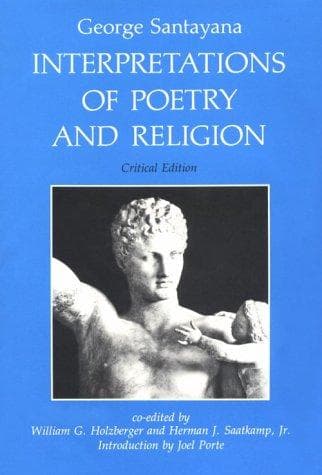
Interpretations of Poetry and ReligionSantayana, George
Religion
Interpretations of Poetry and Religion
Santayana, George
Aesthetics; Literature -- History and criticism; Poetry; Religion
For why should the natural world ever come to be called a world of
illusion? To call the vivid objects of sense illusory is to compare
them to their disadvantage with something else which we conceive as
more worthy of the title of reality. This deeper reality must be
something ideal, something permanent, something conceived by the
intellect, and which only a man having faith in the intellect could
prefer to the objects of sense or fancy. The Hindoos that our author
thinks so much akin to himself would hardly understand this rational
bias of his thought, this foregone dissatisfaction with a world of
infinite change and indefinite structure. They would accept as a
natural fact that perpetual flux which he emphasizes as a paradox and
laments as a calamity. In spite of his studied immersion in sensuous
illusion, he is still a native of the sphere of intelligible things,
and it is only the difficulty of finding the permanent beings which he
is inclined to look for and in the presence of which he could alone
rest, that makes him linger with tragic self-consciousness in the
region of fleeting shadows. Accordingly we need not be surprised by the
somewhat forced and pessimistic note of a pantheism which is really
exotic, and we may be prepared to find the plastic mind asserting
itself ultimately against that system. So Jean Lahor, after the groups
of thoughts which he puts under the title of "L'orient" and "Le ciel du
Nord," adds another group under the title of "Cosmos."
It would require a philosophical treatise of greater pretentions than
the little book before us to explain fully how this cosmos can arise
out of the chaos of mechanical forces, and how the life and the work
of reason can be superposed upon the life of sense and imagination.
Our author's vision, fixed as it is on concrete images and expressed
in detached epigrams, does not always extend to the philosophical
relations of his thoughts. Yet he offers, perhaps unconsciously, an
admirable variation of that revolution of thought which is associated
with the name of Kant. He proposes to us as the work of human
intelligence what is commonly believed to be the work of God. The
universe, apart from us, is a chaos, but it may be made a cosmos by our
efforts and in our own minds. The laws of events, apart from us, are
inhuman and irrational, but in the sphere of human activity they may be
dominated by reason. We are a part of the blind energy behind Nature,
but by virtue of that energy we impose our purposes on the part of
Nature which we constitute or control. We can turn from the stupefying
contemplation of an alien universe to the building of our own house,
knowing that, alien as it is, that universe has chanced to blow its
energy also into our will and to allow itself to be partially dominated
by our intelligence. Our mere existence and the modicum of success we
have attained in society, science, and art are the living proofs of
this human power.
Public-domain text, read in full here on John Shaqi.
Reviews
Reviews
No reviews yet
Be the first to share your thoughts on this work.
Elsewhere in the archive
Join the Discussion
Join the discussion
Sign in to leave a comment or review.
Sign InorCreate an account