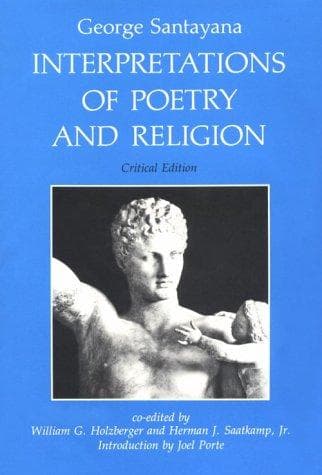
Interpretations of Poetry and ReligionSantayana, George
Religion
Interpretations of Poetry and Religion
Santayana, George
Aesthetics; Literature -- History and criticism; Poetry; Religion
interrupts the true vision of the object, and a great poet, rising to
a perfect conception of the sun and forgetting himself, would have
disdained to make it; but it has a romantic and pathological interest,
it restores an experience, and is in that measure poetical. We have
been made to halt at the sensation, and to penetrate for a moment into
its background of dream.
But it is not only thoughts or images that the poet draws in this
way from the store of his experience, to clothe the bare form of
conventional objects: he often adds to these objects a more subtle
ornament, drawn from the same source. For the first element which the
intellect rejects in forming its ideas of things is the emotion which
accompanies the perception; and this emotion is the first thing the
poet restores. He stops at the image, because he stops to enjoy. He
wanders into the by-paths of association because the by-paths are
delightful. The love of beauty which made him give measure and cadence
to his words, the love of harmony which made him rhyme them, reappear
in his imagination and make him select there also the material that
is itself beautiful, or capable of assuming beautiful forms. The link
that binds together the ideas, sometimes so wide apart, which his wit
assimilates, is most often the link of emotion; they have in common
some element of beauty or of horror.
The poet's art is to a great extent the art of intensifying emotions
by assembling the scattered objects that naturally arouse them. He
sees the affinities of things by seeing their common affinities with
passion. As the guiding principle of practical thinking is some
interest, so that only what is pertinent to that interest is selected
by the attention; as the guiding principle of scientific thinking
is some connection of things in time or space, or some identity of
law; so in poetic thinking the guiding principle is often a mood or a
quality of sentiment. By this union of disparate things having a common
overtone of feeling, the feeling is itself evoked in all its strength;
nay, it is often created for the first time, much as by a new mixture
of old pigments Perugino could produce the unprecedented limpidity of
his colour, or Titian the unprecedented glow of his. Poets can thus
arouse sentiments finer than any which they have known, and in the act
of composition become discoverers of new realms of delightfulness and
grief. Expression is a misleading term which suggests that something
previously known is rendered or imitated; whereas the expression is
itself an original fact, the values of which are then referred to
the thing expressed, much as the honours of a Chinese mandarin are
attributed retroactively to his parents. So the charm which a poet, by
his art of combining images and shades of emotion, casts over a scene
or an action, is attached to the principal actor in it, who gets the
benefit of the setting furnished him by a well-stocked mind.
Public-domain text, read in full here on John Shaqi.
Reviews
Reviews
No reviews yet
Be the first to share your thoughts on this work.
Elsewhere in the archive
Join the Discussion
Join the discussion
Sign in to leave a comment or review.
Sign InorCreate an account