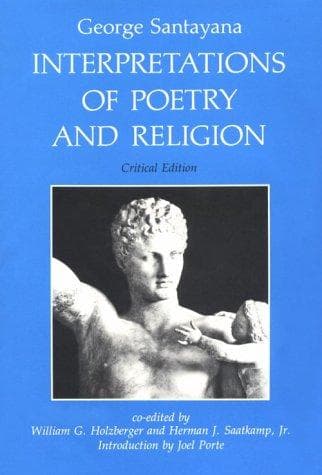
Interpretations of Poetry and ReligionSantayana, George
Religion
Interpretations of Poetry and Religion
Santayana, George
Aesthetics; Literature -- History and criticism; Poetry; Religion
This supreme function of poetry is only the consummation of the method
by which words and imagery are transformed into verse. As verse breaks
up the prosaic order of syllables and subjects them to a recognizable
and pleasing measure, so poetry breaks up the whole prosaic picture
of experience to introduce into it a rhythm more congenial and
intelligible to the mind. And in both these cases the operation is
essentially the same as that by which, in an intermediate sphere, the
images rejected by practical thought, and the emotions ignored by
it, are so marshalled as to fill the mind with a truer and intenser
consciousness of its memorable experience. The poetry of fancy, of
observation, and of passion moves on this intermediate level; the
poetry of mere sound and virtuosity is confined to the lower sphere;
and the highest is reserved for the poetry of the creative reason. But
one principle is present throughout,--the principle of Beauty,--the art
of assimilating phenomena, whether words, images, emotions, or systems
of ideas, to the deeper innate cravings of the mind.
Let us now dwell a little on this higher function of poetry and try to
distinguish some of its phases.
The creation of characters is what many of us might at first be
tempted to regard as the supreme triumph of the imagination. If we
abstract, however, from our personal tastes and look at the matter
in its human and logical relations, we shall see, I think, that the
construction of characters is not the ultimate task of poetic fiction.
A character can never be exhaustive of our materials: for it exists
by its idiosyncrasy, by its contrast with other natures, by its
development of one side, and one side only, of our native capacities.
It is, therefore, not by characterization as such that the ultimate
message can be rendered. The poet can put only a part of himself into
any of his heroes, but he must put the whole into his noblest work.
A character is accordingly only a fragmentary unity; fragmentary in
respect to its origin,--since it is conceived by enlargement, so to
speak, of a part of our own being to the exclusion of the rest,--and
fragmentary in respect to the object it presents, since a character
must live in an environment and be appreciated by contrast and by the
sense of derivation. Not the character, but its effects and causes,
is the truly interesting thing. Thus in master poets, like Homer and
Dante, the characters, although well drawn, are subordinate to the
total movement and meaning of the scene There is indeed something
pitiful, something comic, in any comprehended soul; souls, like other
things, are only definable by their limitations. We feel instinctively
that it would be insulting to speak of any man to his face as we should
speak of him in his absence, even if what we say is in the way of
praise: for absent he is a character understood, but present he is a
force respected.
Public-domain text, read in full here on John Shaqi.
Reviews
Reviews
No reviews yet
Be the first to share your thoughts on this work.
Elsewhere in the archive
Join the Discussion
Join the discussion
Sign in to leave a comment or review.
Sign InorCreate an account