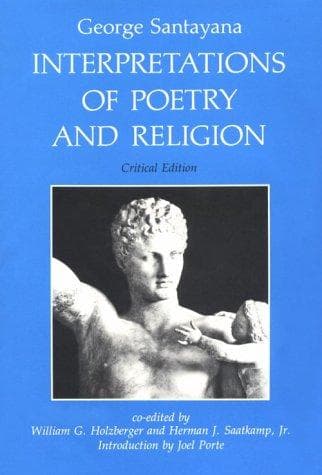
Interpretations of Poetry and ReligionSantayana, George
Religion
Interpretations of Poetry and Religion
Santayana, George
Aesthetics; Literature -- History and criticism; Poetry; Religion
The great function of poetry, which we have not yet directly mentioned,
is precisely this: to repair to the material of experience, seizing
hold of the reality of sensation and fancy beneath the surface of
conventional ideas, and then out of that living but indefinite
material to build new structures, richer, finer, fitter to the primary
tendencies of our nature, truer to the ultimate possibilities of the
soul. Our descent into the elements of our being is then justified by
our subsequent freer ascent toward its goal; we revert to sense only to
find food for reason; we destroy conventions only to construct ideals.
Such analysis for the sake of creation is the essence of all great
poetry. Science and common sense are themselves in their way poets of
no mean order, since they take the material of experience and make out
of it a clear, symmetrical, and beautiful world; the very propriety of
this art, however, has made it common. Its figures have become mere
rhetoric and its metaphors prose. Yet, even as it is, a scientific and
mathematical vision has a higher beauty than the irrational poetry of
sensation and impulse, which merely tickles the brain, like liquor,
and plays upon our random, imaginative lusts. The imagination of a
great poet, on the contrary, is as orderly as that of an astronomer,
and as large; he has the naturalist's patience, the naturalist's love
of detail and eye trained to see fine gradations and essential lines;
he knows no hurry; he has no pose, no sense of originality; he finds
his effects in his subject, and his subject in his inevitable world.
Resembling the naturalist in all this, he differs from him in the
balance of his interests; the poet has the concreter mind; his visible
world wears all its colours and retains its indwelling passion and
life. Instead of studying in experience its calculable elements, he
studies its moral values, its beauty, the openings it offers to the
soul: and the cosmos he constructs is accordingly an ideal theatre for
the spirit in which its noblest potential drama is enacted and its
destiny resolved.
Public-domain text, read in full here on John Shaqi.
Reviews
Reviews
No reviews yet
Be the first to share your thoughts on this work.
Elsewhere in the archive
Join the Discussion
Join the discussion
Sign in to leave a comment or review.
Sign InorCreate an account