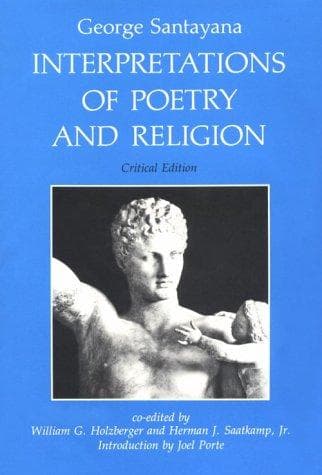
Interpretations of Poetry and ReligionSantayana, George
Religion
Interpretations of Poetry and Religion
Santayana, George
Aesthetics; Literature -- History and criticism; Poetry; Religion
The distinction of a poet--the dignity and humanity of his thought--can
be measured by nothing, perhaps, so well as by the diameter of the
world in which he lives; if he is supreme, his vision, like Dante's,
always stretches to the stars. And Virgil, a supreme poet sometimes
unjustly belittled, shows us the same thing in another form; his
landscape is the Roman universe, his theme the sacred springs of
Roman greatness in piety, consistancy, and law. He has not written a
line in forgetfulness that he was a Roman; he loves country life and
its labours because he sees in it the origin and bulwark of civic
greatness; he honours tradition because it gives perspective and
momentum to the history that ensues; he invokes the gods, because they
are symbols of the physical and moral forces, by which Rome struggled
to dominion.
Almost every classic poet has the topographical sense; he swarms
with proper names and allusions to history and fable; if an epithet
is to be thrown in anywhere to fill up the measure of a line, he
chooses instinctively an appellation of place or family; his wine
is not red, but Samian; his gorges are not deep, but are the gorges
of Hæmus; his songs are not sweet, but Pierian. We may deride their
practice as conventional, but they could far more justly deride ours
as insignificant. Conventions do not arise without some reason, and
genius will know how to rise above them by a fresh appreciation of
their rightness, and will feel no temptation to overturn them in favour
of personal whimsies. The ancients found poetry not so much in sensible
accidents as in essential forms and noble associations; and this fact
marks very clearly their superior education. They dominated the world
as we no longer dominate it, and lived, as we are too distracted to
live, in the presence of the rational and the important.
A physical and historical background, however, is of little moment
to the poet in comparison with that other environment of his
characters,--the dramatic situations in which they are involved. The
substance of poetry is, after all, emotion; and if the intellectual
emotion of comprehension and the mimetic one of impersonation are
massive, they are not so intense as the appetites and other transitive
emotions of life; the passions are the chief basis of all interests,
even the most ideal, and the passions are seldom brought into play
except by the contact of man with man. The various forms of love and
hate are only possible in society, and to imagine occasions in which
these feelings may manifest all their inward vitality is the poet's
function,--one in which he follows the fancy of every child, who puffs
himself out in his day-dreams into an endless variety of heroes and
lovers. The thrilling adventures which he craves demand an appropriate
theatre; the glorious emotions with which he bubbles over must at all
hazards find or feign their correlative objects.
Public-domain text, read in full here on John Shaqi.
Reviews
Reviews
No reviews yet
Be the first to share your thoughts on this work.
Elsewhere in the archive
Join the Discussion
Join the discussion
Sign in to leave a comment or review.
Sign InorCreate an account