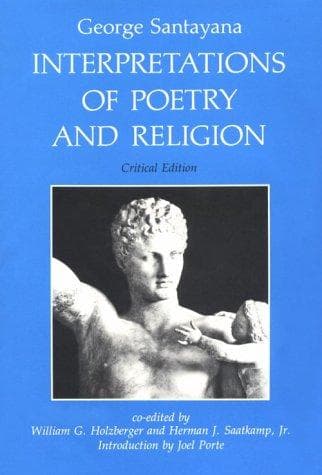
Interpretations of Poetry and ReligionSantayana, George
Religion
Interpretations of Poetry and Religion
Santayana, George
Aesthetics; Literature -- History and criticism; Poetry; Religion
The description of an alien character can serve this purpose only very
imperfectly; but the presentation of the circumstances in which that
character manifests itself will make description unnecessary, since
our instinct will supply all that is requisite for the impersonation.
Thus it seems that Aristotle was justified in making the plot the chief
element in fiction: for it is by virtue of the plot that the characters
live, or, rather, that we live in them, and by virtue of the plot
accordingly that our soul rises to that imaginative activity by which
we tend at once to escape from the personal life and to realize its
ideal. This idealization is, of course, partial and merely relative to
the particular adventure in which we imagine ourselves engaged. But in
some single direction our will finds self-expression, and understands
itself; runs through the career which it ignorantly coveted, and
gathers the fruits and the lesson of that enterprise.
This is the essence of tragedy: the sense of the finished life, of
the will fulfilled and enlightened: that purging of the mind so much
debated upon, which relieves us of pent-up energies, transfers our
feelings to a greater object, and thus justifies and entertains our
dumb passions, detaching them at the same time for a moment from their
accidental occasions in our earthly life. An episode, however lurid,
is not a tragedy in this nobler sense, because it does not work itself
out to the end; it pleases without satisfying, or shocks without
enlightening. This enlightenment, I need hardly say, is not a matter
of theory or of moral maxims; the enlightenment by which tragedy is
made sublime is a glimpse into the ultimate destinies of our will.
This discovery need not be an ethical gain--Macbeth and Othello attain
it as much as Brutus and Hamlet--it may serve to accentuate despair,
or cruelty, or indifference, or merely to fill the imagination for
a moment without much affecting the permanent tone of the mind. But
without such a glimpse of the goal of a passion the passion has not
been adequately read, and the fiction has served to amuse us without
really enlarging the frontiers of our ideal experience. Memory and
emotion have been played upon, but imagination has not brought anything
new to the light.
Public-domain text, read in full here on John Shaqi.
Reviews
Reviews
No reviews yet
Be the first to share your thoughts on this work.
Elsewhere in the archive
Join the Discussion
Join the discussion
Sign in to leave a comment or review.
Sign InorCreate an account