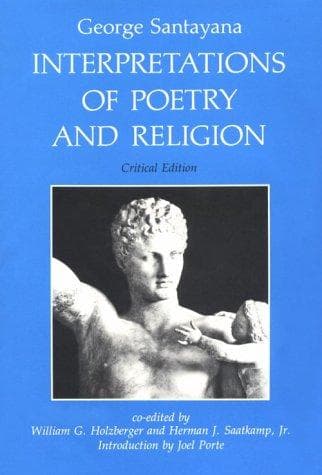
Interpretations of Poetry and ReligionSantayana, George
Religion
Interpretations of Poetry and Religion
Santayana, George
Aesthetics; Literature -- History and criticism; Poetry; Religion
The dramatic situation, however, gives us the environment of a single
passion, of life in one of its particular phases; and although a
passion, like Romeo's love, may seem to devour the whole soul, and
its fortunes may seem to be identical with those of the man, yet much
of the man, and the best part of him, goes by the board in such a
simplification. If Leonardo da Vinci, for example, had met in his youth
with Romeo's fate, his end would have been no more ideally tragic than
if he had died at eighteen of a fever; we should be touched rather by
the pathos of what he had missed, than by the sublimity of what he had
experienced. A passion like Romeo's, compared with the ideal scope of
human thought and emotion, is a thin dream, a pathological crisis.
Accordingly Aristophanes, remembering the original religious and
political functions of tragedy, blushes to see upon the boards a
woman in love. And we should readily agree with him, but for two
reasons,--one, that we abstract too much, in our demands upon art, from
nobility of mind, and from the thought of totality and proportion;
the other, that we have learned to look for a symbolic meaning in
detached episodes, and to accept the incidental emotions they cause,
because of their violence and our absorption in them, as in some sense
sacramental and representative of the whole. Thus the picture of an
unmeaning passion, of a crime without an issue, does not appear to
our romantic apprehension as the sorry farce it is, but rather as a
true tragedy. Some have lost even the capacity to conceive of a true
tragedy, because they have no idea of a cosmic order, of general laws
of life, or of an impersonal religion. They measure the profundity of
feeling by its intensity, not by its justifying relations; and in the
radical disintegration of their spirit, the more they are devoured the
more they fancy themselves fed. But the majority of us retain some
sense of a meaning in our joys and sorrows, and even if we cannot
pierce to their ultimate object, we feel that what absorbs us here
and now has a merely borrowed or deputed power; that it is a symbol
and foretaste of all reality speaking to the whole soul. At the same
time our intelligence is too confused to give us any picture of that
reality, and our will too feeble to marshal our disorganized loves into
a religion consistent with itself and harmonious with the comprehended
universe. A rational ideal eludes us, and we are the more inclined to
plunge into mysticism.
Public-domain text, read in full here on John Shaqi.
Reviews
Reviews
No reviews yet
Be the first to share your thoughts on this work.
Elsewhere in the archive
Join the Discussion
Join the discussion
Sign in to leave a comment or review.
Sign InorCreate an account