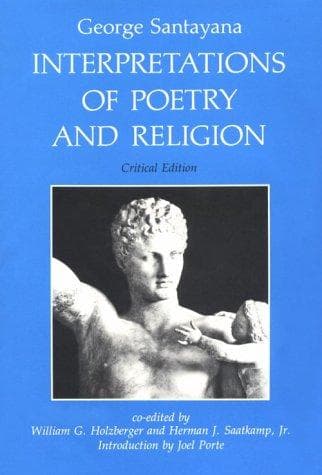
Interpretations of Poetry and ReligionSantayana, George
Religion
Interpretations of Poetry and Religion
Santayana, George
Aesthetics; Literature -- History and criticism; Poetry; Religion
If we may then define poetry, not in the formal sense of giving the
minimum of what may be called by that name, but in the ideal sense
of determining the goal which it approaches and the achievement in
which all its principles would be fulfilled, we may say that poetry is
metrical and euphuistic discourse, expressing thought which is both
sensuous and ideal.
Such is poetry as a literary form; but if we drop the limitation to
verbal expression, and think of poetry as that subtle fire and inward
light which seems at times to shine through the world and to touch the
images in our minds with ineffable beauty, then poetry is a momentary
harmony in the soul amid stagnation or conflict,--a glimpse of the
divine and an incitation to a religious life.
Religion is poetry become the guide of life, poetry substituted
for science or supervening upon it as an approach to the highest
reality. Poetry is religion allowed to drift, left without points of
application in conduct and without an expression in worship and dogma;
it is religion without practical efficacy and without metaphysical
illusion. The ground of this abstractness of poetry, however, is
usually only its narrow scope; a poet who plays with an idea for half
an hour, or constructs a character to which he gives no profound
moral significance, forgets his own thought, or remembers it only as
a fiction of his leisure, because he has not dug his well deep enough
to tap the subterraneous springs of his own life. But when the poet
enlarges his theatre and puts into his rhapsodies the true visions
of his people and of his soul, his poetry is the consecration of his
deepest convictions, and contains the whole truth of his religion. What
the religion of the vulgar adds to the poet's is simply the inertia
of their limited apprehension, which takes literally what he meant
ideally, and degrades into a false extension of this world on its own
level what in his mind was a true interpretation of it upon a moral
plane.
This higher plane is the sphere of significant imagination, of relevant
fiction, of idealism become the interpretation of the reality it
leaves behind. Poetry raised to its highest power is then identical
with religion grasped in its inmost truth; at their point of union
both reach their utmost purity and beneficence, for then poetry loses
its frivolity and ceases to demoralize, while religion surrenders its
illusions and ceases to deceive.
End of the Project Gutenberg EBook of Interpretations of Poetry and Religion, by
George Santayana
Public-domain text, read in full here on John Shaqi.
Reviews
Reviews
No reviews yet
Be the first to share your thoughts on this work.
Elsewhere in the archive
Join the Discussion
Join the discussion
Sign in to leave a comment or review.
Sign InorCreate an account