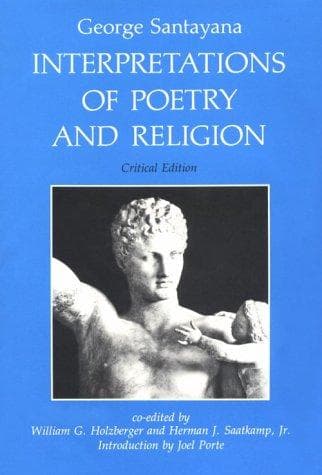
Interpretations of Poetry and ReligionSantayana, George
Religion
Interpretations of Poetry and Religion
Santayana, George
Aesthetics; Literature -- History and criticism; Poetry; Religion
Such insensibility to the highest poetry is no more extraordinary than
the corresponding indifference to the highest religion; nobility and
excellence, however, are not dependent on the suffrage of half-baked
men, but on the original disposition of the clay and the potter; I mean
on the conditions of the art and the ideal capacities of human nature.
Just as a note is better than a noise because, its beats being regular,
the ear and brain can react with pleasure on that regularity, so all
the stages of harmony are better than the confusion out of which they
come, because the soul that perceives that harmony welcomes it as the
fulfilment of her natural ends. The Pythagoreans were therefore right
when they made number the essence of the knowable world, and Plato was
right when he said harmony was the first condition of the highest good.
The good man is a poet whose syllables are deeds and make a harmony in
Nature. The poet is a rebuilder of the imagination, to make a harmony
in that. And he is not a complete poet if his whole imagination is not
attuned and his whole experience composed into a single symphony.
For his complete equipment, then, it is necessary, in the first place,
that he sing; that his voice be pure and well pitched, and that his
numbers flow; then, at a higher stage, his images must fit with one
another; he must be euphuistic, colouring his thoughts with many
reflected lights of memory and suggestion, so that their harmony may
be rich and profound; again, at a higher stage, he must be sensuous and
free, that is, he must build up his world with the primary elements of
experience, not with the conventions of common sense or intelligence;
he must draw the whole soul into his harmonies, even if in doing so
he disintegrates the partial systematizations of experience made
by abstract science in the categories of prose. But finally, this
disintegration must not leave the poet weltering in a chaos of sense
and passion; it must be merely the ploughing of the ground before a
new harvest, the kneading of the clay before the modelling of a more
perfect form. The expression of emotion should be rationalized by
derivation from character and by reference to the real objects that
arouse it--to Nature, to history, and to the universe of truth; the
experience imagined should be conceived as a destiny, governed by
principles, and issuing in the discipline and enlightenment of the
will. In this way alone can poetry become an interpretation of life and
not merely an irrelevant excursion into the realm of fancy, multiplying
oar images without purpose, and distracting us from our business
without spiritual gain.
Public-domain text, read in full here on John Shaqi.
Reviews
Reviews
No reviews yet
Be the first to share your thoughts on this work.
Elsewhere in the archive
Join the Discussion
Join the discussion
Sign in to leave a comment or review.
Sign InorCreate an account