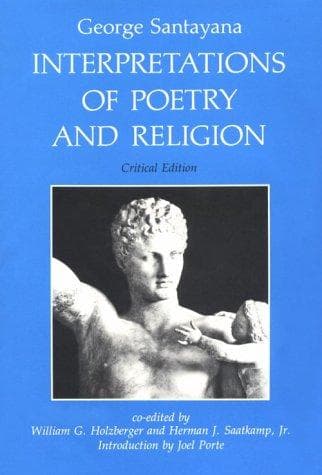
Interpretations of Poetry and ReligionSantayana, George
Religion
Interpretations of Poetry and Religion
Santayana, George
Aesthetics; Literature -- History and criticism; Poetry; Religion
Thus the establishment of the Dorian god in Phocis is explained, and
the wealth and dignity of his temple are justified by prophecy and
by divine intention. For Apollo is not satisfied with repeatedly
describing the future temple, by an incidental epithet, as opulent;
that hint would not have been enough for the simplicity of those
merchant sailors, new as they were to the mysteries of priestcraft.
It was necessary for Apollo to allay their fears of poverty by a more
explicit assurance that it will be easy for them to live by the altar.
And what is more, Hermes and all the thieves he inspires will respect
the shrine; its treasures, although unprotected by walls, shall be safe
for-ever.
These were truly, as we see, the hymns of a levitical patriotism. With
Homeric breadth and candour they dilated on the miracles, privileges,
and immunities of the sacred places and their servitors, and they thus
kept alive in successive generations an awe mingled with familiar
interest toward divine persons and things which is characteristic of
that more primitive age. Gods and men were then nearer together, and
both yielded more frankly to the tendency, inherent in their nature, to
resemble one another.
The same quality is found in another fragment, the most beautiful and
the most familiar of all. This is the hymn to Demeter in which two
stories are woven together, one telling of the rape of Persephone, and
the other of the reception of Demeter, disguised in her sorrow, into
the household of Celeus, where she becomes the nurse of his infant son
Demophoon. Both stories belong to the religion of Eleusis, where this
version of them seems intended to be sung. The place was sacred to
Demeter and Persephone and its mysteries dealt particularly with the
passage of souls to the nether world and with their habitation there.
The pathetic beauty of the first fable--in which we can hardly abstain
from seeing some symbolical meaning--expresses for us something of the
mystic exaltation of the local rites; while the other tale of Celeus,
his wife, his daughters, and his son, whom his nurse, the disguised
goddess, almost succeeds in endowing with immortality, celebrates the
ancient divine affinities of the chiefs of the Eleusinian state.
Public-domain text, read in full here on John Shaqi.
Reviews
Reviews
No reviews yet
Be the first to share your thoughts on this work.
Join the Discussion
Join the discussion
Sign in to leave a comment or review.
Sign InorCreate an account