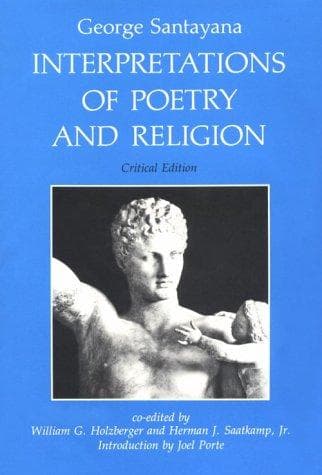
Interpretations of Poetry and ReligionSantayana, George
Religion
Interpretations of Poetry and Religion
Santayana, George
Aesthetics; Literature -- History and criticism; Poetry; Religion
But there was another moral truth which was impressed upon the believer
by that doctrine and which could not be enforced in any other way
without presupposing in him an unusual philosophic acumen and elevation
of mind. That is the truth that moral distinctions are absolute. A
cool philosophy suffices to show us that moral distinctions exist,
since men prefer some experiences to others and can by their action
bring these good and evil experiences upon themselves and upon their
fellows. But a survey of Nature may at the same time impress us with
the fact that these goods and evils are singularly mixed, that there
is hardly an advantage gained which is not bought by some loss, or any
loss which is not an opportunity for the attainment of some advantage.
While it would be chimerical to pretend that such compensation was
always adequate, and that, in consequence, no one condition was ever
really preferable to any other, yet the perplexities into which moral
aspiration is thrown by these contradictory vistas is often productive
of the desire to reach some other point of view, to escape into what
is irrationally thought to be a higher category than the moral. The
serious consideration of those things which are right according to
human reason and interest may then yield to a fanatical reliance on
some facile general notion.
It may be thought, for instance, that what is regular or necessary
or universal is therefore right and good; thus a dazed contemplation
of the actual may take the place of the determination of the ideal.
Mysticism in regard to the better and the worse, by which good and bad
are woven into a seamless garment of sorry magnificence in which the
whole universe is wrapped up, is like mysticism on other subjects; it
consists in the theoretic renunciation of a natural attitude, in this
case of the natural attitude of welcome and repulsion in the presence
of various things. But this category is the most fundamental of all
those that the human mind employs, and it cannot be surrendered so
long as life endures. It is indeed the conscious echo of those vital
instincts by whose operation we exist. Levity and mysticism may do all
they can--and they can do much--to make men think moral distinctions
unauthoritative, because moral distinctions may be either ignored or
transcended. Yet the essential assertion that one thing is really
better than another remains involved in every act of every living
being. It is involved even in the operation of abstract thinking, where
a cogent conclusion, being still coveted, is assumed to be a good, or
in that æsthetic and theoretic enthusiasm before cosmic laws, which is
the human foundation of this mysticism itself.
Public-domain text, read in full here on John Shaqi.
Reviews
Reviews
No reviews yet
Be the first to share your thoughts on this work.
Elsewhere in the archive
Join the Discussion
Join the discussion
Sign in to leave a comment or review.
Sign InorCreate an account