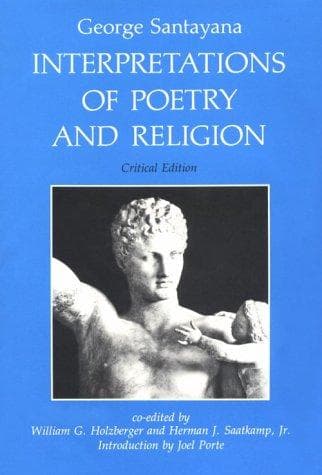
Interpretations of Poetry and ReligionSantayana, George
Religion
Interpretations of Poetry and Religion
Santayana, George
Aesthetics; Literature -- History and criticism; Poetry; Religion
It is accordingly a moral truth which no subterfuge can elude, that
some things are really better than others. In the daily course of
affairs we are constantly in the presence of events which by turning
out one way or the other produce a real, an irrevocable, increase of
good or evil in the world. The complexities of life, struggling as it
does amidst irrational forces, may make the attainment of one good
the cause of the unattainableness of another; they cannot destroy
the essential desirability of both. The niggardliness of Nature
cannot sterilize the ideal; the odious circumstances which make the
attainment of many goods conditional on the perpetration of some evil,
and which punish every virtue by some incapacity or some abuse,--these
odious circumstances cannot rob any good of its natural sweetness, nor
all goods together of their conceptual harmony. To the heart that has
felt it and that is the true judge, every loss is irretrievable and
every joy indestructible. Eventual compensations may obliterate the
memory of these values but cannot destroy their reality. The future can
only furnish further applications of the principle by which they arose
and were justified.
Now, how utter this moral truth imaginatively, how clothe it in an
image that might render its absoluteness and its force? Could any
method be better than to say: Your eternal destiny is hanging in
the balance: the grace of God, the influences of others, and your
own will reacting upon both are shaping at every moment issues of
absolute importance. What happens here and now decides not merely
incidental pains and pleasures--which perhaps a brave and careless
spirit might alike despise--but helps to determine your eternal
destiny of joy or anguish, and the eternal destiny of your neighbour.
In place of the confused vistas of the empirical world, in which the
threads of benefit and injury might seem to be mingled and lost, the
imagination substituted the clear vision of Hell and Heaven; while
the determination of our destiny was made to depend upon obedience to
recognized duties.
Public-domain text, read in full here on John Shaqi.
Reviews
Reviews
No reviews yet
Be the first to share your thoughts on this work.
Elsewhere in the archive
Join the Discussion
Join the discussion
Sign in to leave a comment or review.
Sign InorCreate an account