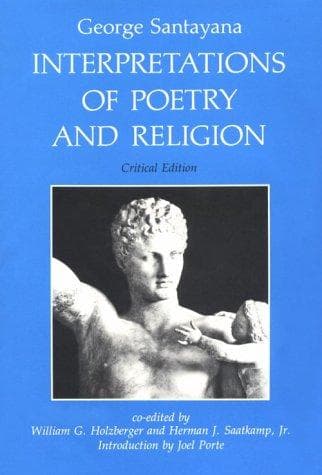
Interpretations of Poetry and ReligionSantayana, George
Religion
Interpretations of Poetry and Religion
Santayana, George
Aesthetics; Literature -- History and criticism; Poetry; Religion
Now these duties may often have been far from corresponding to those
which reason would impose; but the intention and the principle at least
were sound. It was felt that the actions and passions of this world
breed momentous values, values which being ideal are as infinite as
values can be in the estimation of reason--the values of truth, of
love, of rationality, of perfection--although both the length of the
experience in which they arise and the number of persons who share
that experience may be extremely limited. But the mechanical measure
of experience in length, intensity, or multiplication has nothing to
do with its moral significance in realizing truth or virtue. Therefore
the difference in dignity between the satisfactions of reason and
the satisfactions of sense is fittingly rendered by the infinite
disproportion between heavenly and earthly joys. In our imaginative
translation we are justified in saying that the alternative between
infinite happiness and infinite misery is yawning before us, because
the alternative between rational failure or success is actually
present. The decisions we make from moment to moment, on which the
ideal value of our life and character depends, actually constitute in a
few years a decision which is irrevocable.
The Christian doctrine of rewards and punishments is thus in harmony
with moral truths which a different doctrine might have obscured.
The good souls that wish to fancy that everybody will be ultimately
saved, subject a fable to standards appropriate to matters of fact,
and thereby deprive the fable of that moral significance which is its
excuse for being. If every one is ultimately saved, there is nothing
truly momentous about alternative events: all paths lead more or less
circuitously to the same end. The only ground which then remains
for discriminating the better from the worse is the pleasantness or
unpleasantness of the path to salvation. All moral meanings inhere,
then, in this life, and the other life is without significance. Heaven
comes to replace life empirically without fulfilling it ideally. We are
reduced for our moral standards to phenomenal values, to the worth of
life in transitory feeling. These values are quite real, but they are
not those which poetry and religion have for their object. They are
values present to sense, not to reason and imagination.
Public-domain text, read in full here on John Shaqi.
Reviews
Reviews
No reviews yet
Be the first to share your thoughts on this work.
Elsewhere in the archive
Join the Discussion
Join the discussion
Sign in to leave a comment or review.
Sign InorCreate an account