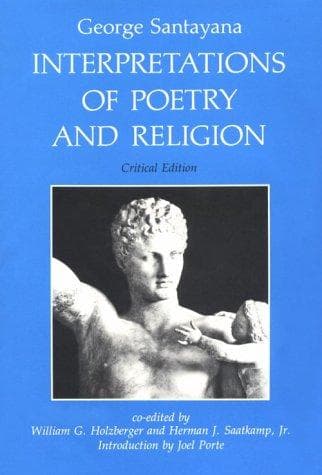
Interpretations of Poetry and ReligionSantayana, George
Religion
Interpretations of Poetry and Religion
Santayana, George
Aesthetics; Literature -- History and criticism; Poetry; Religion
The Church's successes, however, were not all legitimate; they were
not everywhere due to a real correspondence between her forms and the
ideal life of men. It was only the inhabitants of the Græco-Roman
world that were quite prepared to understand her. When the sword, or
the authority of a higher worldly civilization, carried her influence
beyond the borders of the Roman Empire we may observe that her
authority seldom proved stable. She was felt, by those peoples whose
imaginative traditions and whose moral experience she did not express,
to be something alien and artificial. The Teutonic races finally threw
off what they felt to be her yoke. If they reconstructed their religion
out of elements which she had furnished, that was only because religion
is bound to be traditional, and they had been Christians for many
hundred years. A wholly new philosophy or poetry could not have taken
immediate root in their minds; even the philosophy which Germany has
since produced, when the national spirit was reaching, so to speak, its
majority, hardly seems able to constitute an independent religion, but
takes shelter under some form of Christianity, however much the spirit
of that religion may be transformed.
At first, indeed, the new movement took the Bible for its
starting-point. So heterogeneous a book, which was already habitually
interpreted in so many fanciful ways, was indeed an admirable basis
for the imagination to build upon. The self-reliant and dreamy Teuton
could spin out of the Biblical chronicles and rhapsodies convictions
after his own heart; while his fixed persuasion that the Bible was the
word of God, was strengthened (not illegitimately) by his ability to
make it express his own moral ideals. The intensity of his religion was
proportionate to the degree in which he had made it the imaginative
rendering of his own character.
Public-domain text, read in full here on John Shaqi.
Reviews
Reviews
No reviews yet
Be the first to share your thoughts on this work.
Elsewhere in the archive
Join the Discussion
Join the discussion
Sign in to leave a comment or review.
Sign InorCreate an account