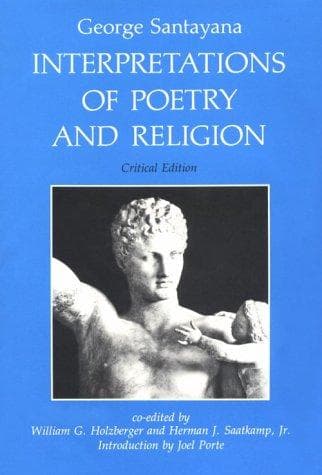
Interpretations of Poetry and ReligionSantayana, George
Religion
Interpretations of Poetry and Religion
Santayana, George
Aesthetics; Literature -- History and criticism; Poetry; Religion
The great success which Christianity achieved in this immense
undertaking makes it, after classic antiquity, the most important phase
in the history of mankind. It is clear, however, that this success was
not complete. That fallacy from which the Pagan religion alone has
been free, that [Greek: proton pseudos] of all fanaticism, the natural
but hopeless misunderstanding of imagining that poetry in order to
be religion, in order to be the inspiration of life, must first deny
that it is poetry and deceive us about the facts with which we have
to deal--this misunderstanding has marred the work of the Christian
imagination and condemned it, if we may trust appearances, to be
transitory. For by this misunderstanding Christian doctrine was brought
into conflict with reality, of which it pretends to prejudge the
character, and also into conflict with what might have been its own
elements, with all excluded religious instincts and imaginative ideals.
Human life is always essentially the same, and therefore a religion
which, like Christianity, seizes the essence of that life, ought to be
an eternal religion. But it may forfeit that privilege by entangling
itself with a particular account of matters of fact, matters irrelevant
to its ideal significance, and further by intrenching itself, by
virtue of that entanglement, in an inadequate regimen or a too narrow
imaginative development, thus putting its ideal authority in jeopardy
by opposing it to other intuitions and practices no less religious than
its own.
Can Christianity escape these perils? Can it reform its claims, or
can it overwhelm all opposition and take the human heart once more by
storm? The future alone can decide. The greatest calamity, however,
would be that which seems, alas! not unlikely to befall our immediate
posterity, namely, that while Christianity should be discredited no
other religion, more disillusioned and not less inspired, should come
to take its place. Until the imagination should have time to recover
and to reassert its legitimate and kindly power, the European races
would then be reduced to confessing that while they had mastered the
mechanical forces of Nature, both by science and by the arts, they had
become incapable of mastering or understanding themselves, and that,
bewildered like the beasts by the revolutions of the heavens and by
their own irrational passions, they could find no way of uttering the
ideal meaning of their life.
V
PLATONIC LOVE IN SOME ITALIAN POETS
Public-domain text, read in full here on John Shaqi.
Reviews
Reviews
No reviews yet
Be the first to share your thoughts on this work.
Elsewhere in the archive
Join the Discussion
Join the discussion
Sign in to leave a comment or review.
Sign InorCreate an account