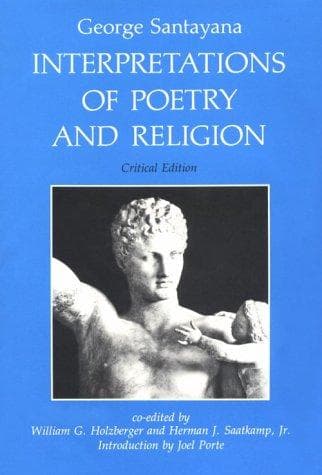
Interpretations of Poetry and ReligionSantayana, George
Religion
Interpretations of Poetry and Religion
Santayana, George
Aesthetics; Literature -- History and criticism; Poetry; Religion
The principle by which the Christian system had developed, although
reapplied by the Protestants to their own inner life, was not
understood by them in its historical applications. They had little
sympathy with the spiritual needs and habits of that Pagan society in
which Christianity had grown up. That society had found in Christianity
a sort of last love, a rejuvenating supersensible hope, and had
bequeathed to the Gospel of Redemption, for its better embodiment and
ornament, all its own wealth of art, philosophy, and devotion. This
embodiment of Christianity represented a civilization through which
the Teutonic races had not passed and which they never could have
produced; it appealed to a kind of imagination and sentiment which
was foreign to them. This embodiment, accordingly, was the object of
their first and fiercest attack, really because it was unsympathetic
to their own temperament but ostensibly because they could not find
its basis in those Hebraic elements of Christianity which make up the
greater bulk of the Bible. They did not value the sublime aspiration
of Christianity to be not something Hebraic or Teutonic but something
Catholic and human; and they blamed everything which went beyond the
accidental limits of their own sympathies and the narrow scope of their
own experience.
Yet it was only by virtue of this complement inherited from Paganism,
or at least supplied by the instincts and traditions on which Paganism
had reposed, that Christianity could claim to approach a humane
universality or to achieve an imaginative adequacy. The problem was to
compose, in the form of a cosmic epic, with metaphysical justifications
and effectual starting-points for moral action, the spiritual
autobiography of man. The central idea of this composition was to be
the idea of a Redemption. Around this were to be gathered and moulded
together elements drawn from Hebrew tradition and scripture, others
furnished by Paganism, together with all that the living imagination
of the time could create. Nor was it right or fitting to make a merely
theoretical or ethical synthesis. Doctrine must find its sensible echo
in worship, in art, in the feasts and fasts of the year. Only when
thus permeating life and expressing itself to every sense and faculty
can a religion be said to have reached completion; only then has the
imagination exhausted its means of utterance.
Public-domain text, read in full here on John Shaqi.
Reviews
Reviews
No reviews yet
Be the first to share your thoughts on this work.
Elsewhere in the archive
Join the Discussion
Join the discussion
Sign in to leave a comment or review.
Sign InorCreate an account