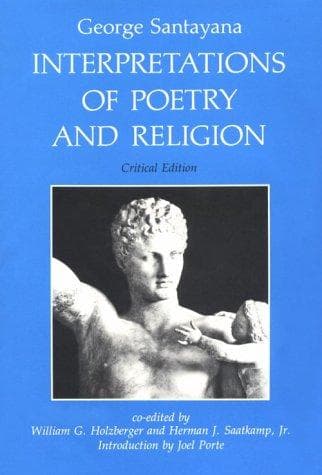
Interpretations of Poetry and ReligionSantayana, George
Religion
Interpretations of Poetry and Religion
Santayana, George
Aesthetics; Literature -- History and criticism; Poetry; Religion
Something of this kind is what we may now attempt to do with regard to
one or two Platonic ideas, ideas which under the often ironical title
of Platonic love, are constantly referred to and seldom understood.
These ideas may be defined as the transformation of the appreciation
of beautiful things into the worship of an ideal beauty and the
transformation of the love of particular persons into the love of God.
These mystical phrases may acquire a new and more human meaning if we
understand, at least in part, how they first came to be spoken. We
shall then not think of them merely as the reported sayings of Plato
or Plotinus, Porphyry or Proclus; we shall not learn them by rote, as
the unhappy student learns the enigmas, which, in the histories of
philosophy, represent all that survives of the doctrine of a Thales or
a Pythagoras. We shall have some notion of the ideas that once prompted
such speech.
And we shall be the better able to reconstruct those conceptions
inasmuch as the reflection by which they are bred has recurred often
in the world--has recurred, very likely, in our own experience.
We are often Platonists without knowing it. In some form or other
Platonic ideas occur in all poetry of passion when it is seasoned with
reflection. They are particularly characteristic of some Italian poets,
scattered from the thirteenth to the sixteenth centuries. These poets
had souls naturally Platonic; even when they had heard something of
Plato they borrowed nothing from him. They repeated his phrases, when
they did so, merely to throw the authority of an ancient philosopher
over the spontaneous suggestions of their own minds. Their Platonism
was all their own: it was Christian, mediæval, and chivalrous, both
in origin and expression. But it was all the more genuine for being a
reincarnation rather than an imitation of the old wisdom.
Nothing, for example, could be a better object-lesson in Platonism than
the well-known sentimental history of Dante. There is no essential
importance in the question whether Dante could have read anything of
Plato or come indirectly under his influence. The Platonism of Dante,
is, in any case, quite his own. It is the expression of his inner
experience moulded by the chivalry and theology of his time. He tells
us the story himself very quaintly in the "Vita Nuova."
Public-domain text, read in full here on John Shaqi.
Reviews
Reviews
No reviews yet
Be the first to share your thoughts on this work.
Elsewhere in the archive
Join the Discussion
Join the discussion
Sign in to leave a comment or review.
Sign InorCreate an account