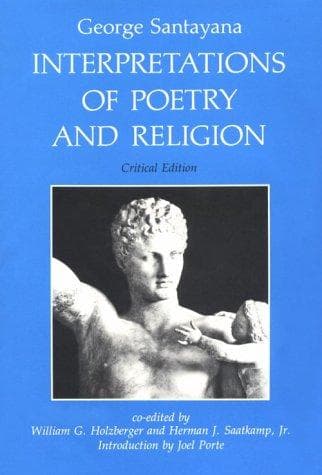
Interpretations of Poetry and ReligionSantayana, George
Religion
Interpretations of Poetry and Religion
Santayana, George
Aesthetics; Literature -- History and criticism; Poetry; Religion
At the age of nine he saw, at a wedding-feast in Florence, Beatrice,
then a child of seven, who became, forthwith, the mistress of his
thoughts. This precocious passion ruled his imagination for life, so
that, when he brings to an end the account of the emotions she aroused
in him by her life and death, he tells us that he determined to speak
no more about her until he should be able to do so more worthily, and
to say of her what had never been said of any woman. In the "Divine
Comedy," accordingly, where he fulfils this promise, she appears
transfigured into a heavenly protectress and guide, whose gentle
womanhood fades into an impersonation of theological wisdom. But this
life-long devotion of Dante to Beatrice was something purely mental
and poetical; he never ventured to woo; he never once descended or
sought to descend from the sphere of silent and distant adoration;
his tenderness remained always tearful and dreamy, like that of a
supersensitive child.
Yet, while his love of Beatrice was thus constant and religious, it
was by no means exclusive. Dante took a wife as Beatrice herself had
taken a husband; the temptations of youth, as well as the affection
of married life, seem to have existed beneath this ideal love, not
unrebuked by it, indeed, but certainly not disturbing it. Should we be
surprised at this species of infidelity? Should we regard it as proof
of the artificiality and hollowness of that so transcendental passion,
and smile, as people have done in the case of Plato himself, at the
thin disguise of philosophy that covers the most vulgar frailties of
human nature? Or, should we say, with others, that Beatrice is a merely
allegorical figure, and the love she is said to inspire nothing but a
symbol for attachment to wisdom and virtue? These are old questions,
and insoluble by any positive method, since they cannot be answered by
the facts but only by our interpretation of them. Our solution can have
little historical value, but it will serve to test our understanding of
the metaphysics of feeling.
Public-domain text, read in full here on John Shaqi.
Reviews
Reviews
No reviews yet
Be the first to share your thoughts on this work.
Elsewhere in the archive
Join the Discussion
Join the discussion
Sign in to leave a comment or review.
Sign InorCreate an account