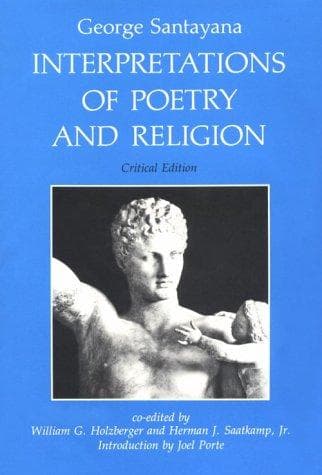
Interpretations of Poetry and ReligionSantayana, George
Religion
Interpretations of Poetry and Religion
Santayana, George
Aesthetics; Literature -- History and criticism; Poetry; Religion
To guide us in this delicate business we may appeal to a friend of
Dante, his fellow-poet Guido Cavalcanti, who will furnish us with
another example of this same sort of idealization, and this same sort
of inconstancy, expressed in a manner that will repay analysis. Guido
Cavalcanti had a Beatrice of his own--something of the kind was then
expected of every gentle knight and poet--and Guido's Beatrice was
called Giovanna. Dante seems to acknowledge the parity of his friend's
passion with his own by coupling the names of the two ladies, Monna
Vanna and Monna Bice, in one or two of the sonnets he addresses to
Guido. Now it came to pass that Guido, in the fervour of his devotion,
at once chivalrous and religious, bethought him of making a pilgrimage
to the tomb of Saint James the Apostle, at Compostela in Spain.
Upon this journey--a journey beguiled, no doubt, by thoughts of the
beautiful Giovanna he had left in Florence--he halted in the city of
Toulouse. But at Toulouse, as chance would have it, there lived a
lovely lady by the name of Mandetta, with whom it was impossible for
the chivalrous pilgrim not to fall in love; for chivalry is nothing
but a fine emblazoning of the original manly impulse to fight every
man and love every woman. Now in an interesting sonnet Guido describes
the conflict of these two affections, or perhaps we should rather say,
their union.
"There is a lady in Toulouse so fair,
So young, so gentle, and so chastely gay,
She doth a true and living likeness bear
In her sweet eyes to Love, whom I obey."
The word I have, to avoid confusion, here rendered by "Love" is in the
original "la Donna mia," "my Lady"; so that we have our poet falling in
love with Mandetta on account of her striking resemblance to Giovanna.
Is this inconstancy or only a more delicate and indirect homage? We
shall see; for Guido goes on to represent his soul, according to his
custom, as a being that dwells and moves about in the chambers of
his heart; and speaking still of Mandetta, the lady of Toulouse, he
continues:--
"Within my heart my soul, when she appeared,
Was filled with longing and was fain to flee
Out of my heart to her, yet was afeared
To tell the lady who my Love might be.
She looked upon me with her quiet eyes,
And under their sweet ray my bosom burned,
Cheered by Love's image, that within them lies."
So far we have still the familiar visible in the new and making its
power; Mandetta is still nothing but a stimulus to reawaken the memory
of Giovanna. But before the end there is trouble. The sting of the
present attraction is felt in contrast to the eternal ideal. There is
a necessity of sacrifice, and he cries, as the lady turns away her
eyes:--
"Alas! they shot an arrow as she turned,
And with a death-wound from the piercing dart
My soul came sighing back into my heart."
Public-domain text, read in full here on John Shaqi.
Reviews
Reviews
No reviews yet
Be the first to share your thoughts on this work.
Elsewhere in the archive
Join the Discussion
Join the discussion
Sign in to leave a comment or review.
Sign InorCreate an account